The $26 Billion Threat: How AI Disinformation Is Reshaping Global Risk in 2026
Nation-state actors have discovered that synthetic information campaigns can move markets faster than missiles. New intelligence reveals the scale, sophistication, and economic impact of AI-driven disinformation—and what organizations are doing to defend against it.
 Konoly
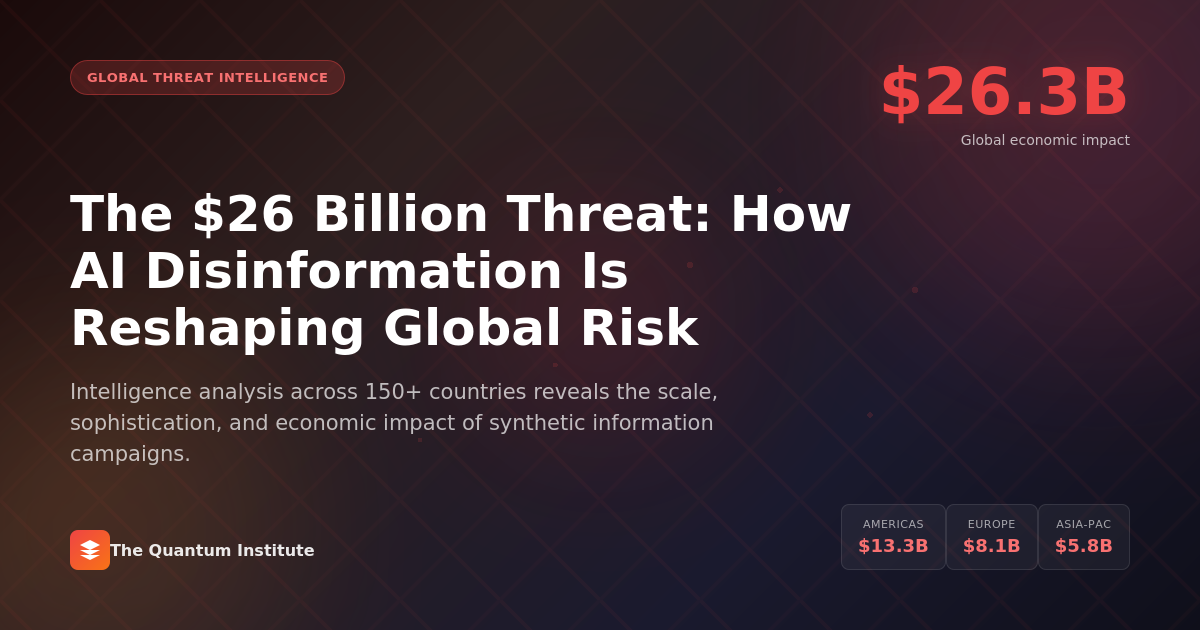
The transformation is stark: what began as crude “troll farms” has evolved into sophisticated “AI farms” capable of generating synthetic content at industrial scale. Research tracking over 1,200 documented campaigns across 150+ countries reveals a threat landscape that has fundamentally changed the risk calculus for multinational organizations. According to analysis published in The Quantum Institute’s AI Disinformation & Security Intelligence Series, coordinated disinformation campaigns targeting corporate interests generated an estimated $26.3 billion in economic impact globally by 2024—with projections indicating 750% growth in campaign volume by 2026. The implications extend far beyond reputational damage. Financial markets now respond to synthetic information within 2.3 seconds on average, faster than human verification is possible. Organizations without detection capabilities are effectively operating blind. The research identifies distinct threat patterns across five global zones, each with unique vulnerability profiles and adversary tactics. North America: Financial System Targeting Primary threat vectors include: Wall Street’s integration of automated trading systems creates particular vulnerability. The research documents instances where AI-generated content moved individual equities 3-7% before human verification could occur. Europe: Democratic Institution Targeting The research identifies Russia as the primary threat actor, with an estimated $2-3 billion annual investment in European influence operations. Key vulnerabilities include: Asia-Pacific: Great Power Competition Taiwan emerges as the highest-risk territory globally (9.3/10 risk score), given its semiconductor manufacturing concentration and existential exposure to cross-strait tensions. The research documents how synthetic content campaigns could amplify supply chain disruption during any Taiwan contingency. Additional regional concerns include: Latin America: Financial Vulnerability Exploitation Brazil’s financial markets and Argentina’s currency crisis present particular targets for synthetic economic intelligence campaigns. The region’s high WhatsApp penetration creates unique distribution vectors not present in other markets. Africa & Middle East: Resource and Stability Targeting Intelligence analysis attributes campaign activity to four primary state actors: Organizations responding to these threats are implementing multi-layered defense strategies. The research documents effective approaches including: Detection Infrastructure Organizational Resilience Intelligence Integration The research projects three potential scenarios for the threat landscape through 2026: For organizations operating across multiple regions, the research underscores the importance of understanding zone-specific threat profiles while building enterprise-wide detection and response capabilities. Detailed regional analysis, threat actor profiles, and corporate defense frameworks are available in The AI Disinformation & Security Intelligence Series 2026 from The Quantum Institute, covering all five global zones with country-specific assessments for 150+ nations. About The Quantum Institute: The Quantum Institute is a strategic intelligence research firm providing analysis on AI-driven threats, cybersecurity, and emerging technology risk to Fortune 500 corporations, government agencies, and institutional investors. Nation-state actors have discovered that synthetic information campaigns can move markets faster than missiles. New intelligence reveals the scale, sophistication, and economic impact of AI-driven disinformation—and what organizations are doing to defend against it.
The Industrialization of Disinformation
Regional Threat Profiles
The Continental United States faces the highest concentration of economically-motivated disinformation campaigns globally. Research documents 340+ campaigns specifically targeting U.S. interests, with projected economic impact of $8.5 billion.
The UK and Europe represent what researchers characterize as “the most sophisticated and contested information warfare environment globally.” With €7.2 billion in projected economic impact, the region faces threats exploiting Brexit divisions, energy security concerns, and EU regulatory debates.
The Asia-Pacific region presents the most complex threat environment, with overlapping campaigns from multiple state actors and $5.8 billion in projected economic impact.
South America and the Caribbean face distinct threats centered on currency volatility, commodity market manipulation, and political instability amplification. Research projects $4.8 billion in regional economic impact.
The 72 nations across Africa and the Middle East face threats targeting energy markets, mining operations, and political stability. With $2.8 billion in projected economic impact, campaigns focus on:The Adversary Landscape
Actor
Campaign Share
Estimated Annual Investment
Russia
32%
$2-3 billion
China
26%
$1.5-2 billion
Iran
8%
$300-500 million
North Korea
3%
$100-200 million
The remaining campaigns originate from non-state actors, criminal organizations, and commercial disinformation-for-hire services—a growing market the research terms “Disinformation-as-a-Service” (DaaS).Corporate Defense Frameworks
Looking Ahead: 2026 Scenarios
Africa & Middle East AI Disinformation Intelligence Report 2026
UK & Europe AI Disinformation Intelligence Report 2026
Asia/China/India/Russia AI Disinformation Intelligence Report 2026
Continental USA AI Disinformation Intelligence Report 2026