The Way of Tea
An Urasenke tea master provides an introduction to the history and practice of Japanese tea ceremony. The post The Way of Tea appeared first on Tricycle: The Buddhist Review.
 Troov
Troov
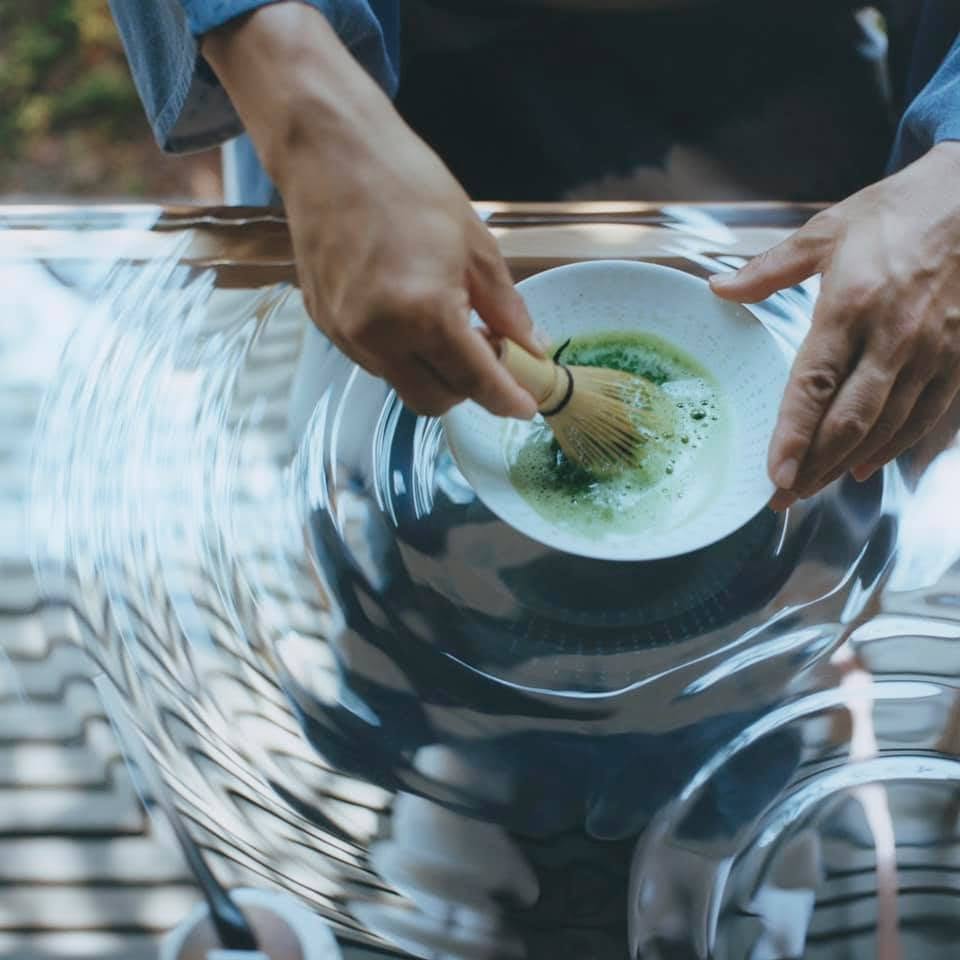
People sometimes feel that the tea ceremony is formal and intimidating, or that it’s a world far removed from everyday life. But in fact, it is closely tied to the everyday.
Art historian Okakura Tenshin wrote in The Book of Tea that “the tea ceremony is a kind of ritual based on the worship of the beautiful in the everyday.” In other words, the tea ceremony is made up of all the ordinary things of daily life.
So, once you have mastered the forms and etiquette of the tea ceremony, your everyday behavior and movements will become naturally beautiful. However, the Way of Tea does not only bring about external changes. It also brings about internal changes, such as how you see and feel things. And these changes will expand your connections with the people around you, bringing about positive changes in society.
About Me
I run and teach the Urasenke tea ceremony school SHUHALLY in Yokohama and Tokyo, and sometimes get involved in company management, and sometimes I share the appeal of the Way of Tea on my YouTube channel. If you’ve seen my videos, you might find that I don’t quite match the image of a “typical tea master.”
Actually, I grew up with no connection to the world of the tea ceremony. I was born into a family unrelated to the tradition, and I was just an ordinary boy who was attracted to things that were a little out of the ordinary. I think I was more interested in foreign street culture and ideas than in Japanese culture.
When I was a student, I traveled around overseas and it was then that I realized for the first time how ignorant I was about the culture of Japan. That made me want to learn about the culture of my own country and this realization sparked a desire: I wanted to understand my own country’s traditions. And so, in my mid-20s, I began studying tea.
When I first started, it was hard to sit on the floor, and there were lots of conventions to learn. I struggled to remember the complicated forms and rules. But as I progressed in my studies, I gradually discovered that each form held meaning, and that a refined aesthetic sensibility had been passed down through generations. At the same time, I began to notice a change within myself.
I naturally became more aware of my everyday behavior, posture and breathing. I realized that the tea utensils, which all looked similar, each had subtle differences. When I walked around town, I noticed small seasonal changes that I had never noticed before, such as the colors of the trees on the street, the sound of the wind, and the scent of the flowers. I felt that I was fulfilled, both in my daily life and in my spiritual life.
I believe that the Way of Tea is not only a comprehensive traditional Japanese art but also the distilled essence of everyday life. By “everyday life” I mean the simple things: the feeling behind words like “thank you,” or when the heart recognizes something as beautiful. Our predecessors poured their wisdom into distilling those sentiments and developing them into an art form. That’s what the tea ceremony is. Which is why the Way of Tea contains elements that allow us to grow as human beings.
I believe that the Way of Tea is not only a comprehensive traditional Japanese art but also the distilled essence of everyday life.
Moreover, the Way of Tea transcends age, gender, nationality, and even language, bringing people together. When I host tea gatherings overseas, everyone smiles as soon as they take a sip. Sometimes, practicing the tea ceremony even feels like you’re communicating with nature or with history itself—an extraordinary sensation. Because the Way of Tea connects all things, I believe it is a cultural activity that can enrich society as a whole.
What Is the Tea Ceremony?
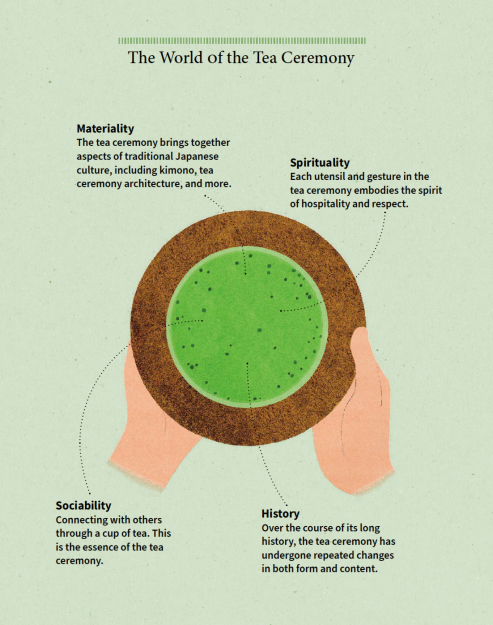
“Would you like some tea?” This is the origin of the tea ceremony. It may seem as if there is a big difference between a guest drinking a cup of matcha in a tea room with a host and having tea with a friend in a café, but as a way of communicating, there is essentially no difference. Depending on the people gathered or the era, tea gatherings have taken on various forms—sometimes involving political maneuvering or the exchange of business-related information. However, the essence of “connecting with others through tea” has continued unchanged from the past to the present.
Of course, there are many differences between simply drinking tea and the tea ceremony. The fact that the history of tea in Japan began with Zen Buddhist monks means that it has a special spirituality at its heart, setting it apart from other traditions. The influence of Zen Buddhism is visible in the way the tea ceremony room is set up and the etiquette observed at a gathering. At the same time, the Way of Tea is also rich in materiality, embodying the essence of traditional Japanese culture through tea utensils, the tea room, kimono, wagashi (traditional sweets), and more.
The true appeal of the Way of Tea lies in its ability to offer both the intangible and the tangible—its spiritual depth and material beauty.
How Long Is the History of Tea?
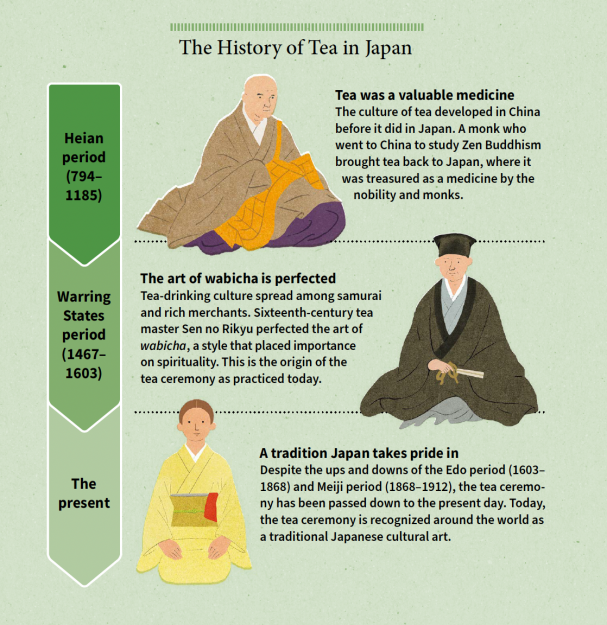
Tea leaves were introduced to Japan during the Heian period (794–1185). A priest who had studied Zen Buddhism in China brought them back as medicine, and they were highly prized by the imperial court and temples.
During the Kamakura period (1185–1333), trainee monks at Zen temples would drink tea to help keep themselves awake. It is said that Eisai, the founder of the Rinzai sect of Zen Buddhism, cured the shogun Minamoto no Sanemoto of a hangover by serving him matcha.
In the Muromachi period (1392–1573) shoguns Ashikaga Yoshimitsu and Yoshimasa collected Chinese tea utensils and held luxurious tea ceremonies, and tea became very popular among samurai and wealthy merchants. In the 15th century, Murata Juko, who is considered to be the founder of wabicha, and his disciples Takeno Jo’o and Kitamuki Dosen, and then Sen no Rikyu, perfected chanoyu. After Rikyu’s death, various schools of tea ceremony were established, including the three Senke schools, founded by Rikyu’s grandson Sotan and other tea masters such as Furuta Oribe and Kobori Enshu. It was around this time that the term sado (the Way of Tea or tea ceremony) came into use.
After the Meiji Restoration in 1868, and the abolition of the samurai class, longtime patrons of the Way of Tea, tea ceremony faced a crisis of survival. But it made a comeback during the early 20th century, becoming popular in the political and business worlds and introduced into girls’ school education. That popularity has continued to the present day.
Why Practice the Tea Ceremony?
The tea ceremony allows you to enjoy connecting with others, and also to become aware of your true self through your five senses. Even if you tend to be introverted, you may enjoy tea ceremony practice.
In the tea ceremony, there is always a host and at least one guest. In that sense, it automatically creates a connection between individuals. At a tea gathering, people who may have never met before come together, united by a single common thread: tea. As they share the same space and moment in time, they gradually open up to one another, and together they begin to co-create the atmosphere of that unique occasion. In my opinion, the tea ceremony can be a wonderful opportunity to enjoy new forms of communication.
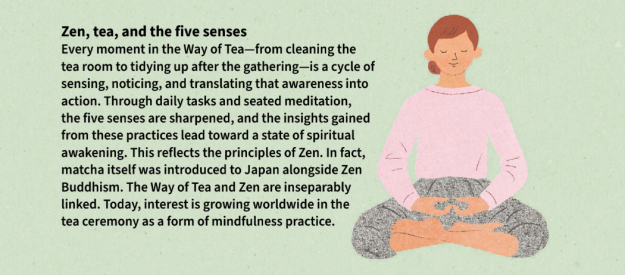
For those among you who are familiar with yoga and meditation, I think there are similarities with tea ceremony practice. The basic essence of yoga and meditation is to focus your consciousness on the here and now, and the tea ceremony is based on exactly that same kind of awareness. The hanging scroll on the wall, the shape of the flower container, the sound of the water boiling in the kettle, the taste of the matcha, the feeling of the tea bowl in your hand—each element of the tea ceremony engages your five senses, inviting you to quietly converse with yourself in every passing moment. Every moment in the Way of Tea—from cleaning the tea room to tidying up after the gathering—is a cycle of sensing, noticing, and translating that awareness into action. Through daily tasks and seated meditation, the five senses are sharpened, and the insights gained from these practices lead toward a state of spiritual awakening.
It is this rare blend—connecting deeply with others while immersing fully in your own inner world—that makes the tea ceremony something that is so uniquely compelling.
Can Anyone Enjoy the Tea Ceremony?
Yes, of course! People often wonder if it requires special knowledge or a certain background, or say that it feels intimidating, but set those assumptions aside for now. The important thing is simply to begin—casually and with an open mind.
When I run a tea ceremony class, I get all sorts of students. There are those who want an opportunity to wear a kimono. Others want to improve their posture and presence so they’ll stand out in a positive way. Some are drawn to the beauty of traditional crafts and want to experience tea utensils firsthand. And others have become interested in Sen no Rikyu through history books or video games. Their ages, goals and motivations vary widely.
There is no need to have a lofty reason or prior knowledge to begin. In the tea ceremony, the basic premise is that everyone is equal in the tea room, so your occupation or title are irrelevant. Most beginners find themselves thinking “What is this world? I don’t understand anything!” but as they continue to try things out, their interest naturally deepens and expands.
Some Japanese people feel the tea ceremony is intimidating perhaps because of its past association with bridal training—a set of skills a young woman was expected to learn in preparation for marriage. Maybe in the old days, making a mistake meant getting sharply corrected by a strict teacher—but that’s no longer the case these days, so there’s no need to worry.
Is It Difficult to Learn the Rules?
Some people say that the tea ceremony has a lot of rules, but it would be more accurate to think in terms of “form” rather than rules. At first, simply learning those forms may feel overwhelming. But over time, as they become second nature, their deeper meanings and intentions begin to reveal themselves through experience.
For example, there are set forms for the way tea is served, but it’s a strange thing that no matter who does it, it will never be the same. The physical characteristics and personality of the person serving the tea will always come through. It is because there are set forms that we can
understand another’s character.
Because there is a common language in the form of the rules, both the host and the guests all move with the same understanding of what will happen next. Each action is performed as if it were a ritual, so concentration naturally increases. This allows you to focus on what is in front of you with peace of mind. And yet, because we’re human, unexpected things inevitably happen. That gap between what was supposed to happen and what actually happens—that surprise—is part of the joy as well.
What Does the Tea Ceremony Offer?
It offers many things, but if I had to sum it up in one word, it would be “enrichment”—from the practical enrichment of beautiful manners, to enriching one’s own spirit and one’s relationship with society.
I think the reason why the tea ceremony has continued to this day is because it enriches our lives. There is both a tangible “practical enrichment” and an intangible “spiritual enrichment” we get from the practice of tea ceremony.
One of the practical benefits of learning the tea ceremony is that it improves posture, helps you to greet people properly, and teaches you to move around in a well-organized way. Even beginners often receive compliments from those around them about their graceful movements. As you advance, the etiquette skills learned from tea may help you in various situations. People may start to see you as someone polished and reliable, and at times, that impression can even lead to helpful connections or opportunities in business.
As you continue your practice, your knowledge deepens—about utensils, seasonal customs, Zen phrases—and with it, your sensitivity grows. You begin to notice beauty in the ordinary: wildflowers by the roadside, the tableware at a restaurant, the phases of the moon, or a thoughtful turn of phrase in conversation. Your sense of appreciation expands.
Beyond that lies a sense of social richness. The values of tea—such as taking care of your tools—resonate with many of our daily social challenges. Through tea, you can cultivate yourself, nurture your surroundings, and in time, help bring greater richness to the world at large. I’m still on that path myself, but I hope to be of service to more people through it.
♦
Adapted from An Illustrated Guide to the Zen Tea Ceremony by Soryo Matsumura © 2026 by Tuttle Publishing. Reprinted by permission.