
Top 10 Local SEO Tools for 2026: Match the Tool to the Job
The most expensive local SEO tool is not necessarily the wrong one. The wrong tool is the one that solves a problem your business does not have. A single-location restaurant might need help keeping its Google Business Profile active....
 MikeTyes
The most expensive local SEO tool is not necessarily the wrong one.
The wrong tool is the one that solves a problem your business does not have.
A single-location restaurant might need help keeping its Google Business Profile active. A local SEO agency may care more about geo-grid capacity and client reporting. A franchise with 500 locations needs governance and listing distribution that would be excessive for an independent plumber.
This is why choosing local SEO software based only on feature count rarely works.
A better approach is to identify the bottleneck first:
Are you invisible in parts of your service area? Is your business information inconsistent? Are competitors collecting more reviews? Is your website failing to support your Google Business Profile? Are reporting tasks consuming too much agency time? Are hundreds of locations becoming difficult to control?The ten tools below solve different parts of the local SEO workflow. Some help measure visibility. Others improve profiles, citations, reviews, websites, or multi-location operations.
Quick Comparison: Which Local SEO Problem Do You Need to Solve?
| Tool | Primary job | Best fit | Pricing model |
| Google Business Profile | First-party profile management | Every eligible local business | Free |
| Grid My Business | Geo-grid tracking connected to optimization | Agencies and growing local businesses | Free tier and paid plans |
| GMB Everywhere | Quick Google Maps competitor research | Freelancers and local SEO audits | Free and paid access |
| Local Falcon | Specialist map-rank visualization | Rank-tracking specialists | Credit-based |
| Whitespark | Citation research | Local SEO consultants | Modular subscriptions and services |
| BrightLocal | Reporting and broad local SEO management | Agencies | Subscription by plan and location count |
| Moz Local | Listings and location-data management | Small and mid-sized organizations | Per-location subscription |
| Localo | Guided profile optimization | Small business owners | Subscription by profile capacity |
| Semrush Local | Local and organic SEO in one ecosystem | Established marketing teams | Per-location plans |
| Yext | Enterprise listings governance | Large multi-location brands | Custom pricing |
1. Google Business Profile: The Essential Starting Point
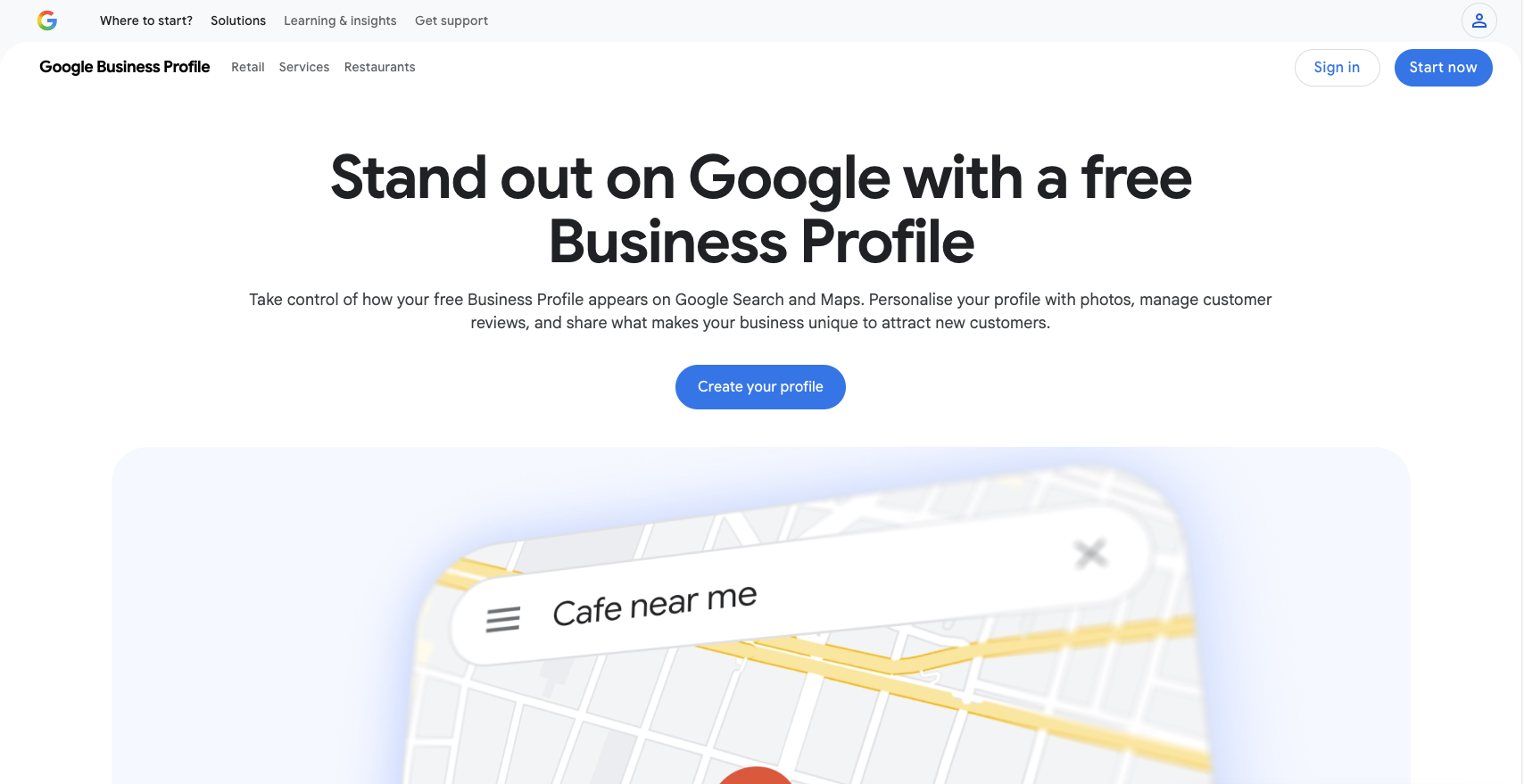
Before buying local SEO software, claim and complete your Google Business Profile.
The profile controls how core business information appears across Google Search and Maps. Owners can update their address, service area, hours, phone number, services, photos, posts, offers, and other information.
They can also respond to reviews and invite additional owners or managers without sharing account passwords.
No third-party platform can compensate for a neglected or inaccurate profile. If the business name is misleading, the primary category is wrong, or the listed opening hours are unreliable, reporting software will only document the problem.
Google recommends using a business’s real-world name, maintaining an accurate address or service area, and selecting only the categories needed to describe the core business.
Choose it when: You operate any eligible local or service-area business.
Why it earns a place: It is the direct and free foundation on which most other local SEO platforms depend.
Watch for: Google Business Profile does not provide geo-grid tracking, detailed competitor analysis, citation distribution, or customizable agency reports.
For additional guidance, see this guide to optimizing a Google Business Profile for local SEO.
2. Grid My Business: Best for Connecting Map Rankings With Action
A conventional rank tracker may report that a business ranks fifth for a target keyword.
That number can be misleading because local results change with the searcher’s location. A business might rank in the top three near its storefront while disappearing from the local pack several neighborhoods away.
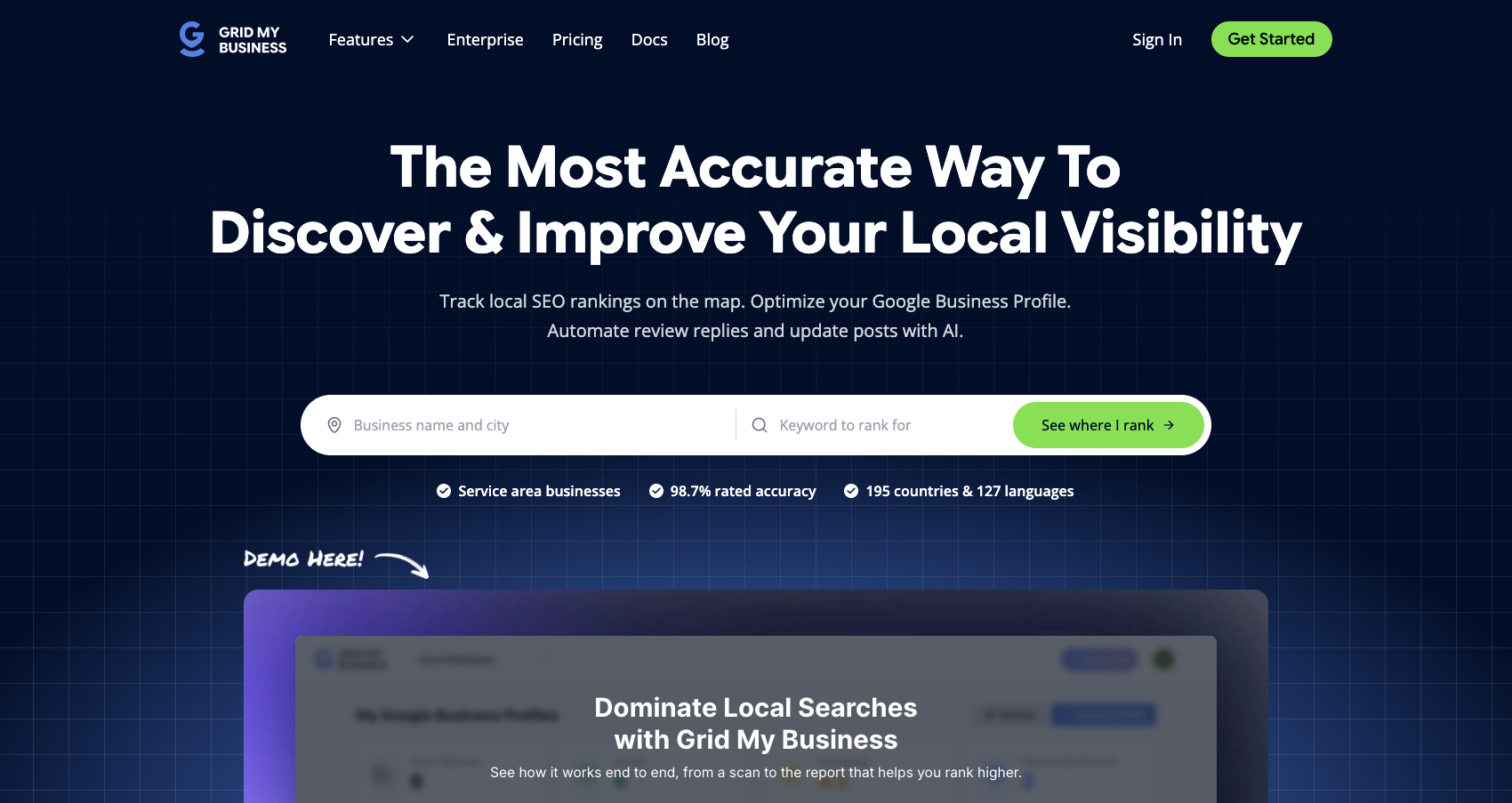
Grid My Business measures this variation using geo-grid scans. Each grid point represents a search from a different map coordinate, producing a neighborhood-level view of local visibility.
Users can change the scan distance, reposition individual pins, remove irrelevant points, and monitor rankings on a schedule.
Flexible pin control is useful when the target area contains rivers, airports, industrial zones, or neighborhoods outside the real service territory. It helps businesses concentrate credits and reporting on the areas where potential customers are actually located.
The platform also supports service-area businesses. This makes it relevant to plumbers, cleaners, electricians, mobile technicians, and other companies that travel to customers.
Where Grid My Business Gains an Edge
Many tools are good at showing ranking data. Grid My Business connects that data with a broader optimization workflow.
Users can monitor competitors, examine Google Business Profile performance, check citations, manage reviews and posts, generate optimization recommendations, and create white-label reports.
Its competitor tools can also monitor changes made to nearby profiles. This helps marketers identify when a competitor changes categories, receives new reviews, increases photo activity, or strengthens other profile signals.
Grid My Business also provides MCP access for compatible AI assistants. This allows approved AI tools to work with information such as ranking history, profile analysis, keyword performance, and competitor data.
For agencies, another advantage is account capacity. The Growth plan supports up to 100 business profiles, while higher plans support 300 or unlimited profiles.
This may be more economical than tools that charge separately for every active client location.
Choose it when: You need geo-grid tracking, competitor intelligence, profile optimization, engagement, and client reporting in one workflow.
Why it earns a place: It connects local ranking measurement with actions intended to improve the result.
Watch for: Credit usage depends on the number of keywords, grid size, and scanning frequency. Agencies should calculate expected usage before scheduling every keyword across every client.
The free plan includes 250 scan credits and two business profiles. Paid plans currently begin at $29 per month on monthly billing.
3. GMB Everywhere: Best for Fast Competitor Research
Not every local SEO question requires a complete campaign dashboard.
Sometimes you need to open Google Maps, inspect the businesses that rank, and quickly determine which categories, services, reviews, and posting patterns they use.
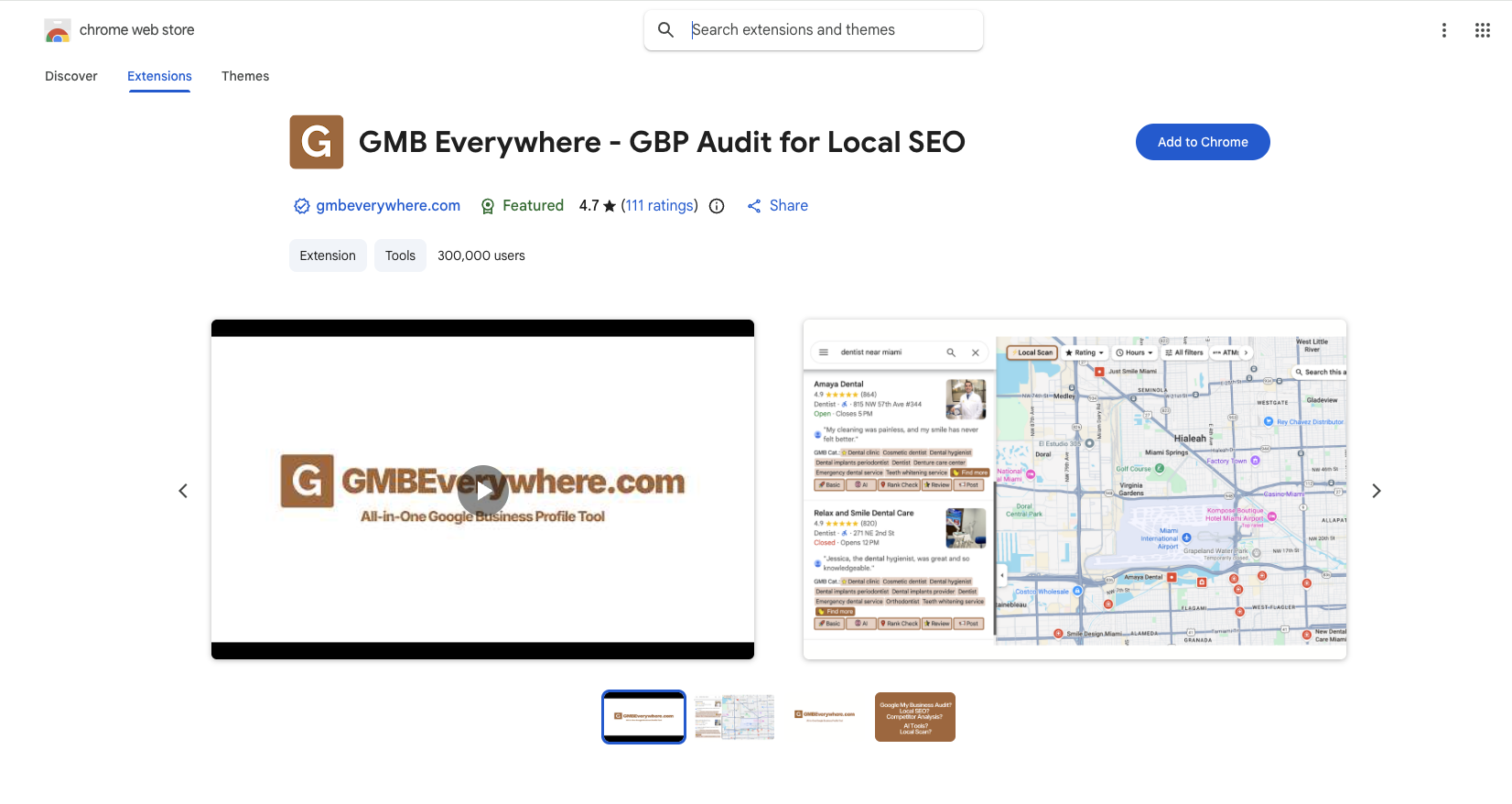
GMB Everywhere adds this information directly to Google Maps and local search results through a browser extension.
The extension can reveal primary and secondary categories, compare competing profiles, audit reviews, inspect posts, and analyze selected local website signals.
This is useful during prospecting, initial audits, and competitor research. A consultant can investigate a local market without first configuring a complete rank-tracking campaign.
Its category information can be particularly helpful. A business may appear relevant to a search because of a secondary category that is not immediately visible through a normal Google Maps result.
Choose it when: You need quick answers while browsing Google Maps.
Why it earns a place: It minimizes the distance between seeing a competitor and analyzing that competitor.
Watch for: Browser-based audits are not a replacement for scheduled monitoring, historical reports, or listings distribution.
GMB Everywhere is free to start, with additional capabilities available through paid access.
4. Local Falcon: Best for Specialist Geo-Grid Analysis
Local Falcon is one of the best-known specialist geo-grid platforms.
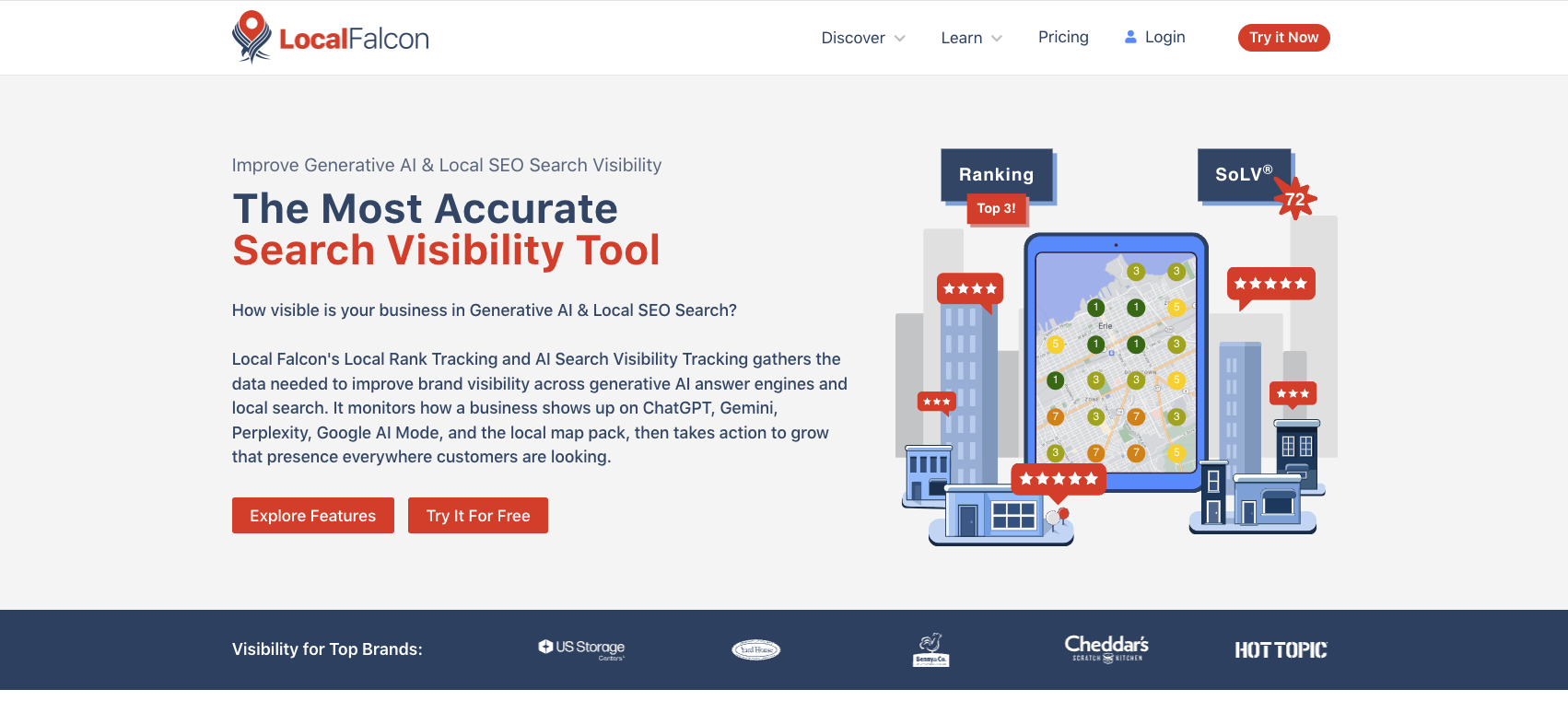
Its reports show how rankings change across a selected map area. The platform also calculates Share of Local Voice, a metric designed to summarize how frequently a business appears prominently throughout the grid.
Users can monitor campaigns over time, compare competitors, review business categories, and export or share reports.
Local Falcon has expanded beyond Google Maps to include Apple Maps and selected AI-search visibility features. This gives marketers a wider view of how location-based brands appear across emerging discovery channels.
The platform is especially useful when detailed geographic analysis is more important than citations, content publishing, or listing distribution.
Choose it when: Detailed map-rank visualization is the main requirement.
Why it earns a place: It offers a focused and mature workflow for analyzing geographic visibility.
Watch for: Credit usage increases with grid size and scanning frequency. It is less focused on citation management than broader local SEO platforms.
Local Falcon offers introductory scan credits. Paid plans are based largely on credit usage and required features.
5. Whitespark: Best for Citation Discovery
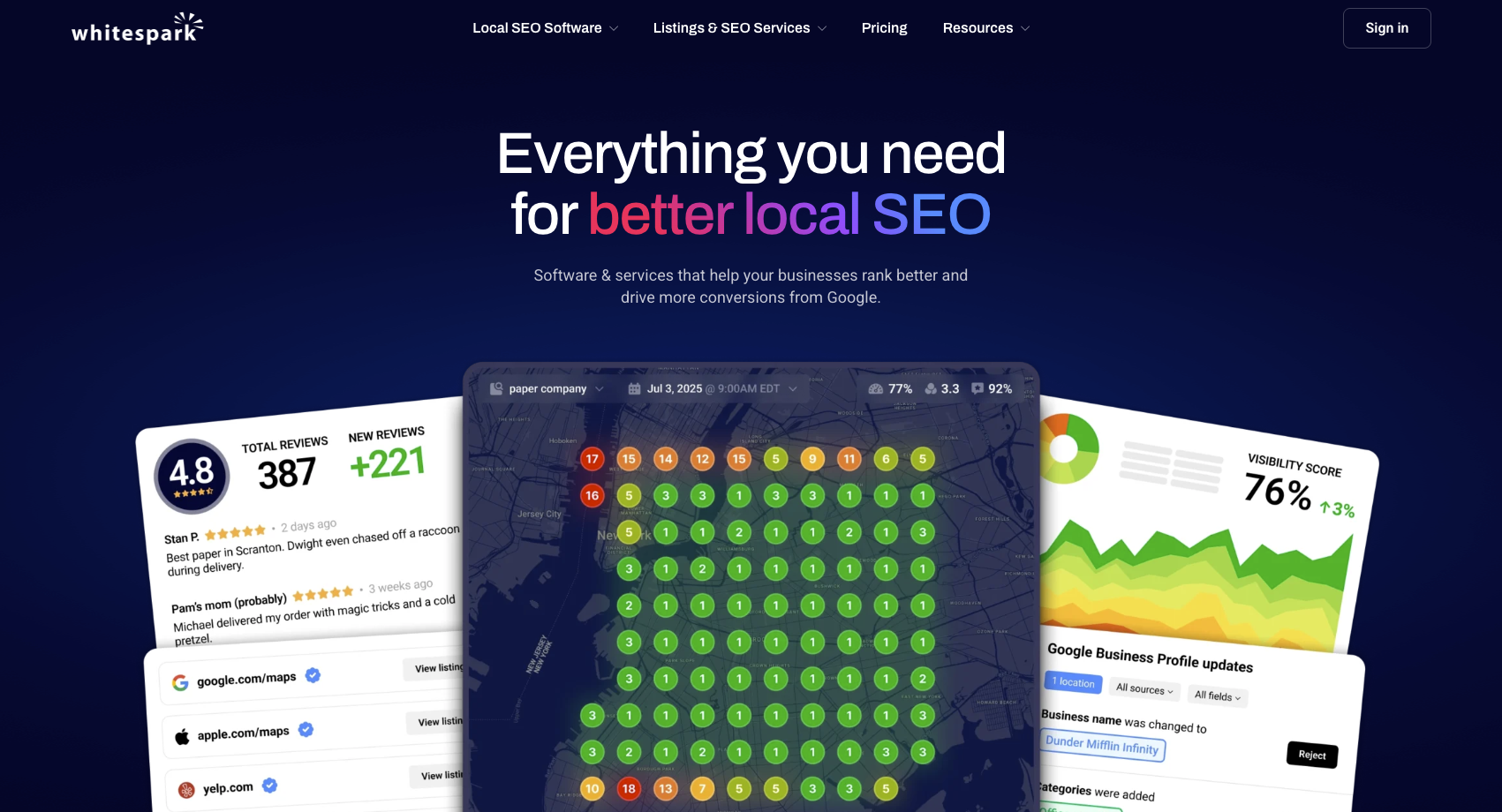
Citations are mentions of a business’s name, address, and phone number across directories, applications, industry websites, and other platforms.
Finding the right citation opportunities can be difficult because useful sources vary by country, city, and industry.
Whitespark is particularly strong in this area. Its Local Citation Finder helps users discover where competitors are listed, identify missing opportunities, and monitor existing citations.
Whitespark uses a modular pricing model. Its citation research, local ranking grids, conventional rank tracker, reputation tools, and professional services can be purchased separately.
This is useful for experienced marketers who do not want to pay for a bundled platform when they only need one specialist function.
A consultant, for example, may use one platform for geo-grid tracking while turning to Whitespark only when a client needs deeper citation research or cleanup.
Choose it when: Citation research and cleanup are the immediate priorities.
Why it earns a place: Its citation research is more specialized than the basic citation checks included in many all-in-one products.
Watch for: Combining several Whitespark products can create a more fragmented workflow than using one unified platform.
Its Local Ranking Grids currently start at $10 per month, while other tools and services have separate pricing.
6. BrightLocal: Best for Broad Agency Reporting
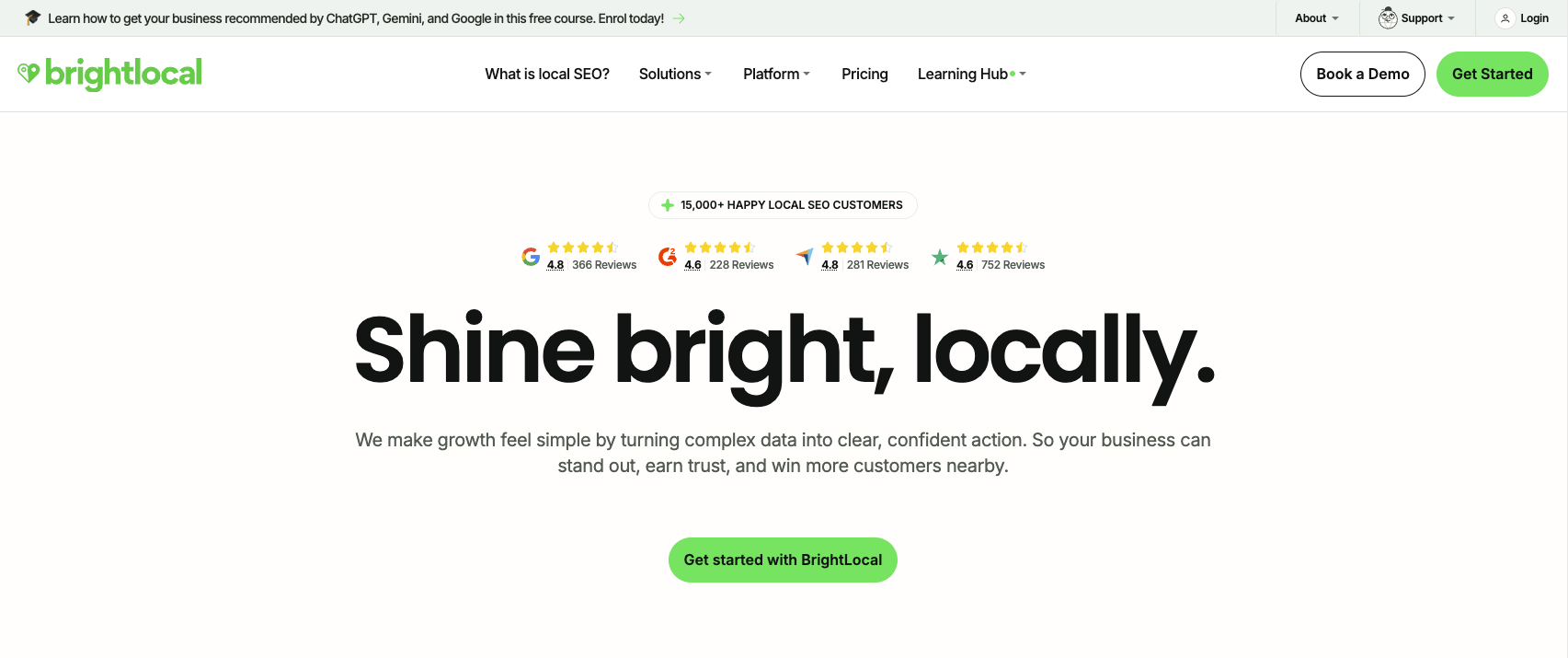
BrightLocal brings several common local SEO jobs into one platform.
Its capabilities include traditional rank tracking, geo-grid scans, profile audits, citation monitoring, listings management, reputation management, and client reporting.
Its strongest appeal is not one individual feature. It is the ability to combine multiple local-search signals into reports that clients and stakeholders can understand.
An agency can use these reports to show whether rankings, reviews, citations, and profile performance are moving in the right direction.
BrightLocal also offers citation building separately from its regular subscriptions. Businesses can purchase individual citations without necessarily committing to recurring listing-management fees for every directory.
Choose it when: Your agency needs reporting across rankings, profiles, citations, listings, and reviews.
Why it earns a place: It provides a mature set of local SEO reporting and audit capabilities.
Watch for: Features are distributed across different plans. Costs also rise as the number of active locations increases.
BrightLocal’s entry pricing currently starts at approximately $29 per month when billed annually for one location.
7. Moz Local: Best for Straightforward Listings Management
A local business can have accurate information on its Google Business Profile while still showing an old address, incorrect phone number, or outdated opening hours elsewhere.
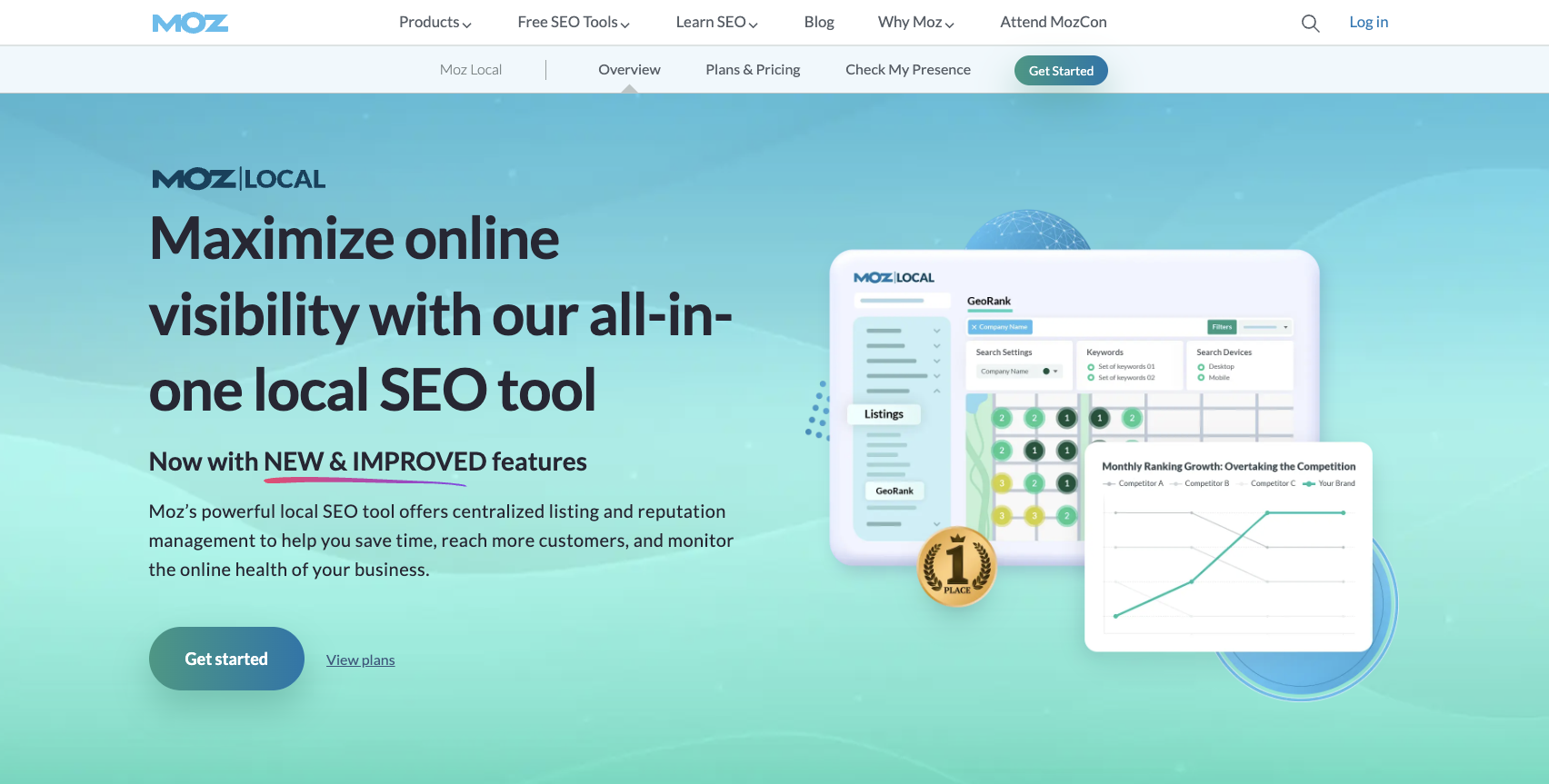
Moz Local is designed to reduce these inconsistencies by distributing and synchronizing business information across search engines, directories, applications, and social platforms.
Users can manage core location data from one dashboard, monitor listing completeness, identify duplicates, and review performance across multiple locations.
Its review-management features also bring customer feedback into one place and help identify recurring themes in reviews.
Moz Local sits between specialist citation-research tools and complex enterprise platforms. It is broader than manually finding citation opportunities, but more approachable than a large location-governance system.
Choose it when: Your biggest problem is maintaining consistent business information across several platforms.
Why it earns a place: It provides a relatively straightforward way to manage listings, duplicates, and review activity.
Watch for: Moz Local is less specialized in geo-grid rank tracking and competitor analysis. Businesses may need a separate platform to understand neighborhood-level visibility.
8. Localo: Best for Guided Optimization
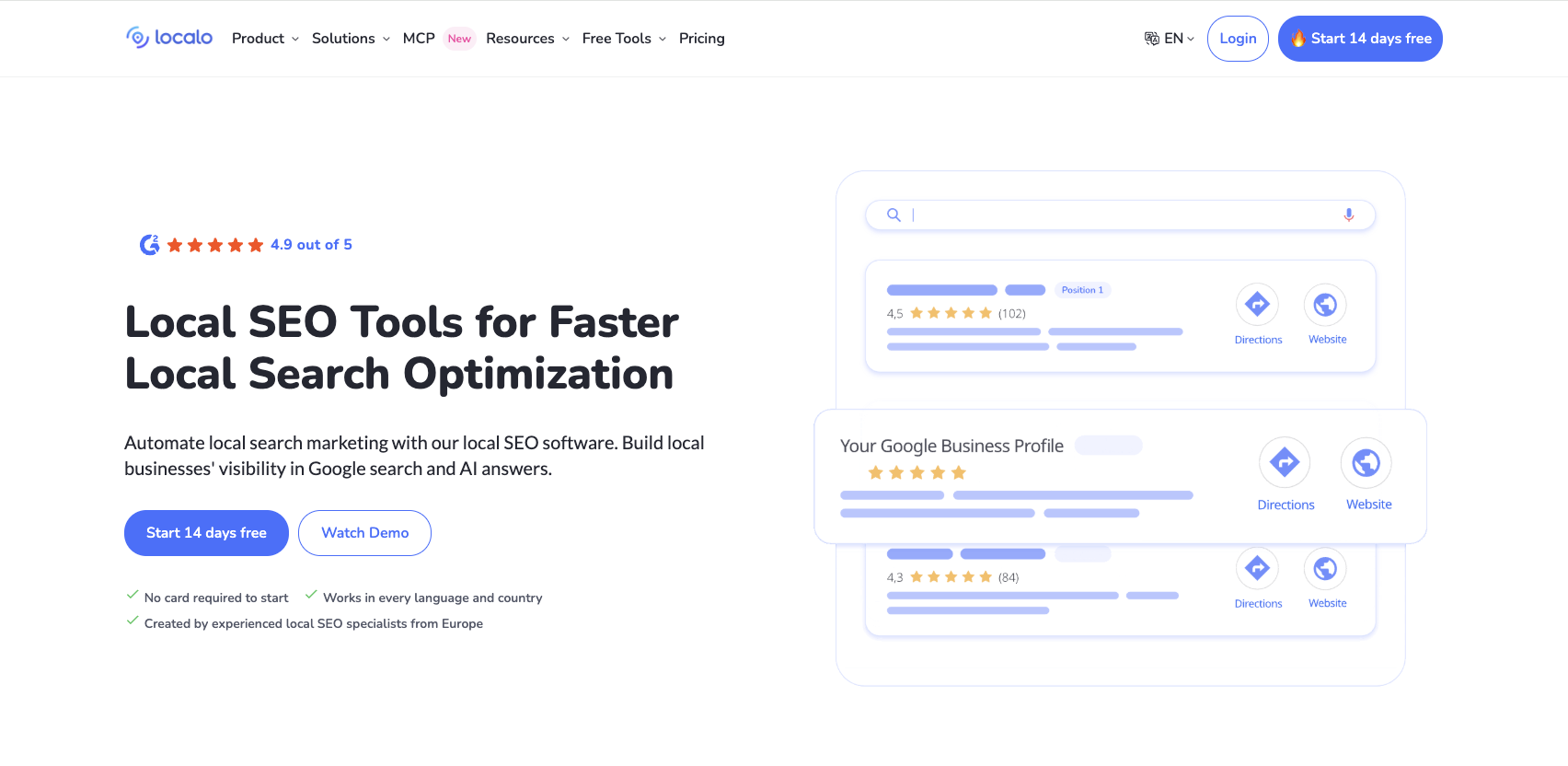
Some platforms tell users what happened. Localo is designed to help them decide what to do next.
After analyzing a Google Business Profile and its competitors, Localo generates optimization tasks.
It also includes position-map tracking, competitor monitoring, review management, post scheduling, citation tools, and profile protection.
This guided approach is useful for business owners who do not have an in-house SEO specialist. Instead of interpreting every metric, they can work through a structured list of recommendations.
Localo can also help owners maintain a more regular profile-management routine. This matters because many local businesses optimize their profiles once and then neglect them for months.
Choose it when: You want practical tasks instead of a dashboard full of raw data.
Why it earns a place: It lowers the learning curve for ongoing Google Business Profile optimization.
Watch for: The single-business plan covers one profile. Agency and multi-profile access requires more expensive plans.
Localo currently offers a trial, followed by paid plans based on profile and optimization capacity.
9. Semrush Local: Best for Combining Local and Organic SEO
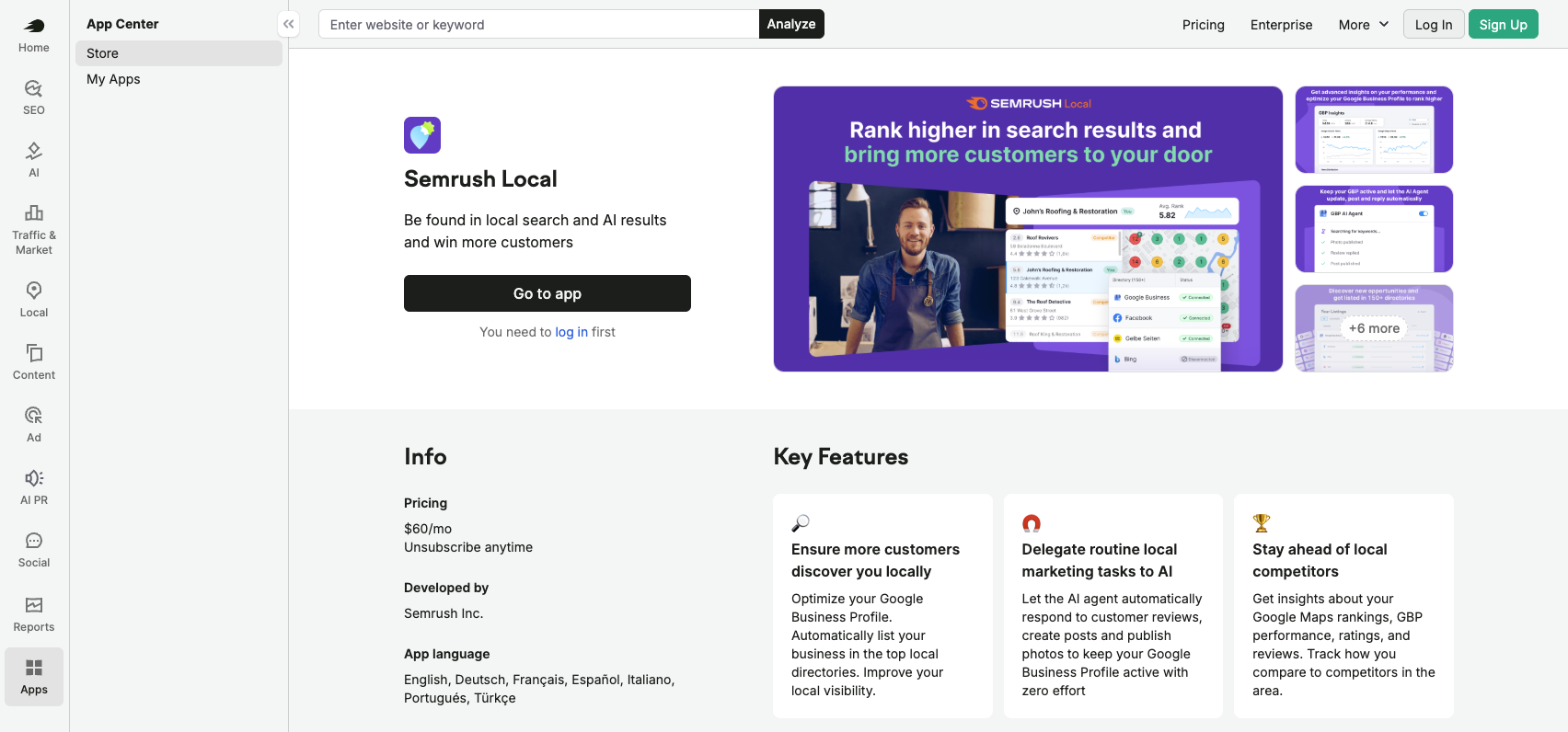
Local visibility and organic website visibility are closely related, but many tools treat them as separate projects.
Semrush Local connects local features with the wider Semrush ecosystem. That ecosystem includes keyword research, backlink analysis, technical site auditing, competitor research, and conventional position tracking.
Its local tools include a geo-grid Map Rank Tracker and AI-assisted Google Business Profile management.
Higher plans add listing distribution, review generation, review monitoring, and advanced profile-management features.
This combination is useful when the same marketing team manages the local pack, organic results, content, links, and technical SEO.
A team can investigate whether a visibility problem is limited to Google Maps or is part of a wider weakness affecting the website.
Choose it when: The same team manages local SEO, content, links, and technical SEO.
Why it earns a place: Local performance can be analyzed beside broader search-marketing data.
Watch for: Local plans are priced per location, and the wider Semrush ecosystem can become expensive.
Semrush Local currently starts at $30 per month per location when billed annually.
10. Yext: Best for Enterprise Location Governance
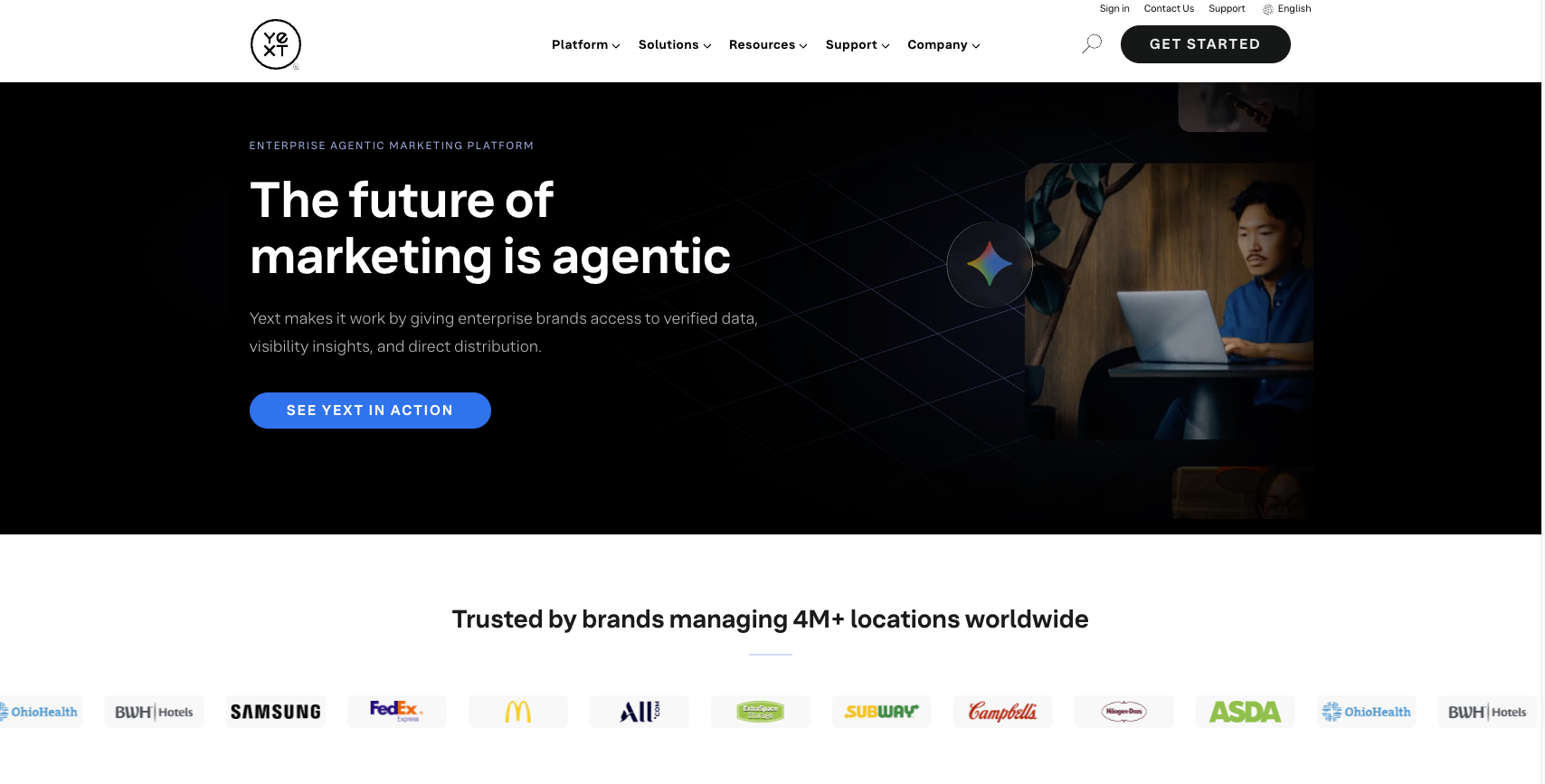
A business with five locations may need efficient reporting. A business with 5,000 locations needs governance.
Yext is designed for large organizations that must manage location data, permissions, reviews, pages, and publisher distribution at scale.
The platform distributes structured business information through more than 200 publisher integrations.
It also supports reviews, local pages, social publishing, search experiences, and AI-search visibility.
Yext is especially relevant to franchises, financial institutions, healthcare organizations, retailers, and other brands with complex approval requirements.
Its role is different from that of a lightweight map-rank tracker. The main value is maintaining control over a large and complicated location portfolio.
Choose it when: Central control and data governance matter more than entry-level affordability.
Why it earns a place: It is built for location portfolios that smaller local SEO tools may struggle to govern.
Watch for: Pricing generally requires a sales conversation. Implementation may also be excessive for a small business.
Build a Stack Around the Bottleneck
Most businesses do not need all ten tools.
The better approach is to combine a few products that solve different layers of local SEO.
Stack for a Single-Location Business
Google Business Profile for direct profile management Grid My Business or Localo for monitoring and optimization Moz Local for listing consistencyStack for a Local SEO Consultant
Grid My Business for geo-grid tracking, competitor intelligence, and reporting GMB Everywhere for quick preliminary audits Whitespark for deeper citation researchStack for a Growing Agency
Grid My Business or BrightLocal for campaign management and reports Moz Local or Whitespark for citation and listing work Semrush for technical, keyword, backlink, and organic-search analysisStack for an Enterprise Brand
Yext for listing distribution and governance Semrush for broader search analysis Grid My Business or Local Falcon for neighborhood-level map visibilityQuestions to Ask Before Purchasing
Before committing to a local SEO platform, calculate the real workload.
How Many Profiles Will You Manage?
A low entry price can become expensive when every additional location requires a separate subscription.
Look beyond the headline price and calculate the cost for the total number of profiles you expect to manage within the next year.
How Many Keywords Will You Scan?
A geo-grid platform may charge by credits, pins, keywords, or campaigns.
A 7 by 7 grid consumes more resources than a 3 by 3 grid. Tracking ten keywords across twenty profiles also creates a very different credit requirement from tracking two keywords for one location.
How Often Do Rankings Need to Update?
Daily scans are not always necessary.
Weekly or three-day monitoring may be enough to identify meaningful trends. More frequent scans can be useful during an active campaign, but they may also consume credits without changing the decisions being made.
Do You Need Data or Recommendations?
Experienced consultants may prefer flexible data exports and granular controls.
Business owners may gain more value from guided tasks, automated review replies, and clear optimization recommendations.
Who Will Read the Reports?
An internal SEO specialist may be comfortable with raw data.
Clients and executives usually need visual summaries, clear trends, and prioritized next steps. If reporting is a major part of the workflow, evaluate the white-label, sharing, and export options before subscribing.
Are You Solving a Ranking Problem or a Conversion Problem?
A business may already rank well but still receive few calls or visits.
In that case, better photos, stronger reviews, more accurate services, improved landing pages, or clearer offers may matter more than additional rank tracking.
Ranking data should lead to a business decision. Collecting more data is not automatically the same as improving performance.
For more background, this guide to understanding local rank trackers explains why location-based monitoring provides a more useful view than a single ranking position.
Final Thoughts
The best local SEO stack is not the one with the most features. It is the one that removes the biggest obstacle between the business and better local visibility.
Google Business Profile remains the essential starting point.
Whitespark specializes in citation research, Moz Local focuses on listing consistency, Local Falcon provides detailed geo-grid visualization, and Yext addresses enterprise governance.
Grid My Business is particularly compelling for agencies and growing local businesses because it connects geo-grid measurement with competitor intelligence, optimization, engagement, and reporting.
That connected workflow matters.
Finding a ranking gap is useful, but the real value comes from understanding the gap, acting on it, and measuring whether the action worked.
Updated: 13 August 2026
About Aaron Jackson
Passionate about weaving words into engaging narratives, I am a blog and article writer dedicated to creating content that not only informs but also inspires dialogue and deepens understanding. Join me on a journey through compelling stories and insightful discussions. #Writer #ContentCreator








![Does Google Favor UGC? Reddit Leads In Search Growth [STUDY] via @sejournal, @MattGSouthern](https://www.searchenginejournal.com/wp-content/uploads/2025/01/img_2025-01-23-193114-772.jpg)




![Websites Using AI Content Grow 5% Faster [+ New Research Report]](https://ahrefs.com/blog/wp-content/uploads/2025/06/websites-using-ai-content-grow-5-by-ryan-law-data-studies.jpg)

















.jpg&h=630&w=1200&q=100&v=7abd35f457&c=1)