The Living Form of Zen
Why monastic practice still matters in the digital age The post The Living Form of Zen appeared first on Tricycle: The Buddhist Review.
 Konoly

At dawn in the Colorado San Luis Valley, a wooden han sounds through the mountain-rimmed valley at Crestone Mountain Zen Center. The air is cold and thin; stillness spreads silently through the meditation hall as practitioners settle on their tatami mats. The same ritual unfolds thousands of miles away at the Zen Buddhist Center Schwarzwald in Germany.
Across cities and even continents, people join these still seated meditations—in person and online. As the bell fades, stillness arises—and unfolds. Somatically, palpably, mutually. It connects through space—and, mysteriously, even through time.
The Trust That Trains the Heart
Monastic life may revolve around stillness, but it is built on trust. Not the trust of shared opinions but a more profound sense of reliability. A trust that each of us will keep showing up. Each in our own ways, with our own struggles, and with our own questions. But each to refine our conduct, to face ourselves, and to immerse our minds together.
This kind of trust isn’t an abstract idea. It emerges in particular encounters and then is nurtured through the very encounter in which it emerged. I first noticed it one morning during an ango (ninety-day practice period) at Crestone Mountain Zen Center. If there is such a thing as a dark night of the soul, it stands to reason that there might be a dark morning of the soul too. Well, on one particular morning, darkness took hold of me. I did not know how I would carry myself through the next hour, let alone the day. Too fragile to be in the world. Too unmade. A thought formed; I could feel it being born: “I wish there were someone, anyone, who could take this pain away from me.” Of course, I knew it wasn’t possible.
As I turned to practice kinhin (Jp.: walking meditation), my eyes met the eyes of another practitioner. Usually, he would have turned away, but now he didn’t. He stayed present for a moment, just long enough. His eyes were warm. A smile. A small nod.
We never spoke about it. I have no idea what he saw, or whether he was seeing anything at all. But it meant the world. It changed the world. It turned the world around for me. This moment showed me what a monastery is—what it can and should be: a field of shared attention that one can trust.
It creates a form of sanity that can’t be manufactured by individual effort.
Zen as Culture, Not Content
When we speak of Buddhism in the West, we often describe it as a philosophy or a set of techniques. But Zen is not content you can learn and then know; it’s a way of being together that must be transmitted like culture.
Culture moves faster than words. It shapes how we walk, gesture, think, and see. You can’t learn it from a book—you absorb it through participation and intimacy.
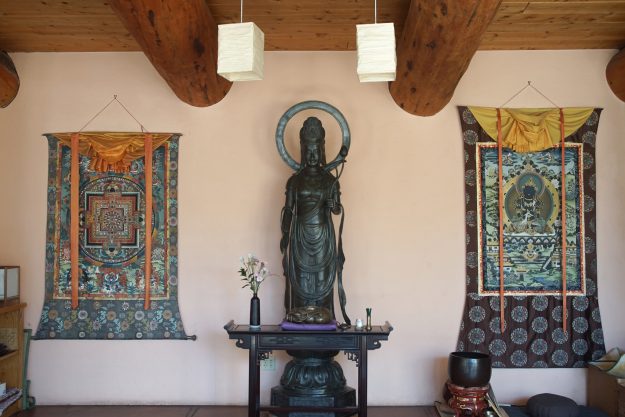 An altar featuring Kannon-Do at Crestone Mountain Zen Center in Colorado, US. | Image via Dharma Sangha
We don’t just inhabit a culture—the culture also inhabits us. When the bell sounds for sutra recitation, forty bodies turn together, bow together, chant together—each finding their tune. Suzuki Roshi said: “Don’t chant with your mouth. Chant with your ears!” And he was talking about far more than just listening to the sounds. He was talking about releasing ourselves into a shared field of aliveness, and finding our voice within that.
That’s why monasteries, with their intricate forms and rhythms, still matter. They remain laboratories for embodied culture. Form and aesthetics—the bow, the robe, the placement of a cup—embody the dharma. When practiced within a trustworthy community, they transmit something language fails to reach.
Freedom in Form
Zen can look strange to modern eyes: shaved heads, Japanese robes, the unfamiliar choreography of ritual. Some find it beautiful; others find it austere, inaccessible. Many centers have shed the formalities to appear more approachable. For me, the forms remain a way of participating in the body of the Buddha.
The forms remain a way of participating in the body of the Buddha.
I often speak about the body as mudra—the gesture of awakening itself. Forms like robes and bowing are gestures that embody connection. Zen rituals are a path of gestures: one movement after another, each punctuated by stillness. During kinhin, I often notice how our breathing synchronizes: inhalation, heels lifting; exhalation, feet shuffling. The step is no longer mine; it belongs to the shared field. Instead of living in mental continuity, we begin to live moment to moment wholeheartedly, embodying and clarifying each situation.
At first, form can feel restrictive, but in practice it opens a sense of freedom that comes from surrendering to rhythm. Each gesture grounds us in the living field of relationship. Eventually, bowing feels more natural than shaking hands—not just because we’ve grown familiar with something foreign but because we’ve discovered a way of meeting that is based on connectedness, not separation.
The Inner Landmark
As Zen found its footing in the West, it grew outward into lay life and inward into the monastery. Whenever a practice center was established, everyone’s practice deepened, even those who came only occasionally.
That remains true today. The monastery functions as an inner landmark. Even for lay practitioners who live far away, knowing there’s a place where silence, discipline, and trust are cultivated changes the texture of their own lives.
Thanks to the internet, that inner landmark now extends even beyond monastery walls. Students who have trained in person and then returned home say that joining zazen online—hearing the bell, the quiet settling of the hall—brings the whole body memory back. One told me, “When I hear the bell, I can smell the incense.”
Changing the Address
Zen monasticism relocates the mind into its fundamental nature—a feeling body in a living world. Most of us live from the address of our personal identities—our stories and roles. When you enter a monastery, you change your outer address, but you also change your inner one.
From this new address, the world becomes porous. Steam rises from a cup of tea. The evening bell sounds, and a breeze of mountain air moves through the open door. Everything is meeting everything—mind and world greeting each other in the same rhythm.
That inner address is open, responsive, capable of receiving greetings from the world. To live from that place—awake, embodied, undefended—is the practice itself.
The Practice Continues
Sharing the stillness between bells carries the same charge as a line of Dogen: penetrating, exact, alive. Today, we can practice together—to some extent—even across great distances.
At dawn, the han sounds—striking wood in the darkness, calling everyone to zazen. Across minds and screens, stillness unfolds—and connects.