Microsoft Copilot Harness Explained: How to Build Reliable AI Agents in 2026
Microsoft launched the Copilot harness in Foundry Agent Service public preview on October 28, 2026. Here is what its managed agent execution means for developers.
 Netzender Editorial Team
lead
Microsoft is bringing its Copilot harness to Microsoft Foundry Agent Service in public preview, giving developers a managed way to build agents that can use tools, handle files, delegate bounded work, and complete multi-step tasks. Announced on October 28, 2026, the release is significant because it shifts attention from choosing a powerful AI model to operating that model reliably inside a real workflow.
For teams building research assistants, software-development agents, and internal operations automation, the practical question is no longer just “Which model should we use?” It is “What happens when the agent loses context, a tool fails, or a task runs for hours?” Microsoft's announcement addresses those engineering questions through a managed execution layer, reusable skills, and controls around tools and approvals.
What is the Microsoft Copilot harness?
An AI agent harness is the execution system around an AI model. The model generates decisions and language; the harness coordinates context, tool calls, files, execution steps, and policies so those decisions can become a controlled sequence of actions. Think of the model as an engine and the harness as the transmission, instrumentation, and safety systems that make the engine useful in production.
In Foundry Agent Service, Microsoft's new Copilot harness is a managed option for defining agents declaratively. Microsoft operates the agent loop and sandbox, while developers provide their own instructions, skills, knowledge, and connected tools. The harness is designed to work with supported Foundry models rather than tying the application logic to a single model family.
This is not the same thing as the consumer-facing Microsoft Copilot chat interface. It is a developer-oriented capability within Microsoft's agent-building platform. Availability, supported models, regions, and tool limitations depend on the public-preview configuration.
Why this announcement matters in October 2026
AI demos often look impressive because they show the happy path: ask a question, call a tool, and return an answer. Production workflows are harder. A content-research agent may need to search multiple sources, compare conflicting claims, draft an article, run validation, and ask a human to approve publication. Each stage introduces state, permissions, and opportunities for failure.
Microsoft's October 28 announcement makes the harness a first-class part of its Foundry offering. A separate Microsoft Copilot Studio update on October 29 describes the wider effort to use a common foundation across Copilot experiences. That matters because organizations can evaluate agent orchestration as an architectural choice, rather than treating it as custom glue code every team must maintain.
The company also announced general availability of long-running resilience for hosted agents. This is related but distinct from the public-preview Copilot harness: hosted agents can bring their own frameworks and agent loops, while Foundry helps them recover from infrastructure interruptions. Developers still need checkpoints and idempotent actions to prevent duplicate writes after a restart.
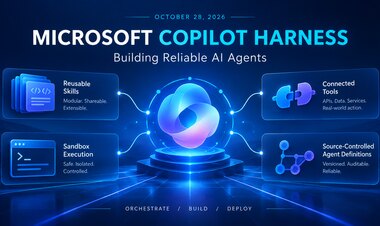
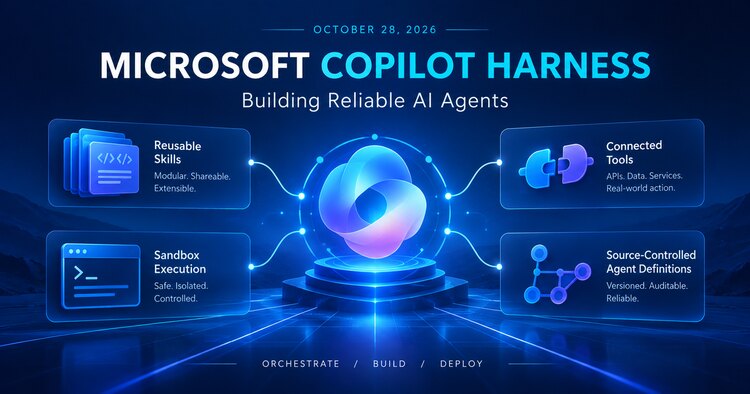
The four building blocks
1. Reusable skills
Skills package repeatable procedures, scripts, and supporting resources into a format an agent can apply when a task calls for them. A research skill might require source dates, evidence checks, and a list of unresolved questions. A publishing skill might insist on SEO metadata, image validation, duplicate detection, and a draft-only result. Keeping procedures reusable makes workflows easier to test and update than embedding every rule in a giant prompt.
2. Connected tools with explicit controls
The harness supports configured Foundry tools and Model Context Protocol (MCP) connections. Tools are what allow an agent to retrieve records, inspect code, analyze files, or request an external action. The important production detail is the boundary around each connection: authentication, approvals, and least-privilege access should be explicit. A content agent that can research topics does not automatically need permission to publish a public page.
3. Execution, files, and bounded delegation
Agents can work with files and code inside a managed execution environment and delegate defined subtasks to built-in subagents. One subagent might collect source material while another checks consistency. The coordinating agent can then combine their outputs. Delegation is useful only when each task has a clear input, expected output, and stopping condition; otherwise it can multiply errors and costs.
4. Source-controlled agent definitions
Agent definitions and related resources can live alongside application code. This gives teams a familiar route to reviews, version history, test fixtures, and controlled releases. It also makes it possible to distinguish a change in model choice from a change in agent instructions or tools—an important distinction when debugging a regression.
How the harness differs from the AI model
A foundation model can reason, summarize, and produce code. The harness determines how that model is supplied with context, which tools it can use, how a sequence of steps is managed, and what happens when an action fails. Improving either layer can improve an agent, but they solve different problems.
Microsoft's October 29 Copilot Studio post reports internal evaluations in which changing the harness improved pass rates by 10.8 percentage points with an OpenAI model and 22.1 percentage points with an Anthropic model relative to a Standard harness on equivalent tasks. These are Microsoft-reported internal results, not independently reproduced benchmarks, and should not be interpreted as guaranteed improvements for every application.
The same post says agents continued attempting to solve a problem after tool failures in 84–91% of evaluated cases with the Copilot harness, versus fewer than 7% with the Standard harness. Continuing to work is not identical to successfully completing the overall task; Microsoft explicitly notes that distinction. The lesson for developers is to evaluate the entire agent system, not only a model leaderboard.
A practical workflow: from research to approved publication
Consider a publishing team that wants to automate a daily technology brief without allowing AI to post unreviewed claims. A well-designed workflow could look like this:
- Research: retrieve recent announcements from approved sources and record their publication dates.
- Verification: compare claims with primary documentation and mark anything that cannot be confirmed.
- Draft: create an article, SEO title, description, tags, and image brief.
- Offline validation: check required files, schema, internal links, image format, and potentially unsafe archive paths.
- Private draft: submit only to a staging or non-public CMS state, with duplicate checks.
- Human review: require explicit approval before a separate publishing action becomes available.
- Live QA: after approval, verify the public URL, canonical, headings, and images.
The Copilot harness can help coordinate the reasoning and tool-use portions of such a process, but it does not replace the site's CMS-specific checks or a human approval policy. Teams should treat external pages and retrieved documents as untrusted data, not as instructions that can override the agent's rules.
For a deeper look at building robust systems, see Netzender's agentic AI engineering roadmap, which covers the progression from prototype to tested workflow.
Pricing and availability: what developers should know
Microsoft says the Copilot harness in Foundry Agent Service is in public preview as of October 28, 2026. According to the Foundry announcement, harness runtime billing is scheduled to begin on December 1, 2026. Before then, harness runtime usage is free, while model inference and separately billed tools or connected services can still incur charges.
Microsoft lists starting rates of $0.0994 per vCPU-hour and $0.0118 per GiB-hour for sandbox compute and memory once harness billing begins. These are published reference prices, not a complete estimate of an agent's operating cost; rates may differ by region and commercial agreement.
For example, a hypothetical workload consuming 10 vCPU-hours and 20 GiB-hours would have an illustrative harness compute-and-memory charge of about $1.23 at those rates, excluding model tokens, tools, storage, networking, taxes, and any other charges. This example is arithmetic, not a Microsoft quote or a real deployment bill.
Preview users should check current region and model support, service quotas, and the latest pricing page before committing to a production architecture. Microsoft notes that an existing agent cannot yet switch its harness type after creation in this preview.
Copilot harness vs hosted agents vs simple prompt agents
Not every automation needs a full managed harness. Microsoft describes three approaches within Foundry Agent Service:
- Prompt agents without the Copilot harness: useful when instructions and supported tools are enough for a bounded task.
- Prompt agents with the Copilot harness: a fit for workflows that benefit from managed execution, reusable skills, file handling, and subagent coordination.
- Hosted agents: appropriate when teams need to own or customize the framework, agent loop, or middleware while using Foundry-managed hosting.
The right choice depends on task complexity, operational control, compliance needs, and the total cost of ownership. An organization already using a reliable internal workflow engine may have less to gain from replacing it than a team currently maintaining a fragile collection of scripts and prompt chains.
Production risks and design safeguards
Tool permissions and prompt injection
Agent workflows often consume documents, webpages, and repository files that may contain malicious or misleading instructions. Restrict tools to the minimum required scope, validate untrusted input, and never allow retrieved content to authorize privileged actions. Approval requirements should be enforced by the application, not merely requested in a prompt.
Retries, checkpoints, and duplicate writes
Recovery is valuable, but restarting a job can repeat a side effect. Before creating a record, charging a card, or publishing a page, use an idempotency key or check the authoritative system for an existing result. Persist checkpoints outside transient conversation context so a resumed task knows what has already happened.
Observability and evaluation
Track task success, human corrections, tool errors, retry counts, cost, and time to completion. Build regression tests using representative tasks, not just polished demos. Evaluate whether an agent produces the correct outcome under bad inputs, missing permissions, conflicting sources, and network failures.
Human approval for irreversible actions
Draft creation and public publication should be separate operations. The same principle applies to financial transactions, account changes, and customer-facing messages. A strong harness can coordinate actions, but organizations still need explicit authorization for consequences that cannot easily be undone.
How to get started with a small pilot
Begin with one narrow, measurable workflow. Define the expected output and failure conditions before selecting the model. Write a reusable skill that explains how to verify sources and produce a structured result. Connect only read-only tools initially, then add a sandbox for file processing and a draft-only output action.
Store agent definitions and tests in version control. Run a small evaluation set covering normal requests, missing data, contradictory sources, and tool failures. Add metrics and checkpoints before attempting long-running execution. Finally, put an explicit review step between the agent's proposed result and any public or irreversible action.
This staged approach lets a team measure whether a managed harness genuinely improves reliability. The goal is not to maximize the number of autonomous steps; it is to make each step understandable, recoverable, and safe.
Frequently asked questions
Is Microsoft Copilot harness a new AI model?
No. It is an orchestration and execution layer for agents built with supported models in Microsoft Foundry.
Can it publish content or modify external systems automatically?
An agent can be configured with tools that perform actions, but the permitted operations depend on tool connections, authentication, and approval controls. Public publishing should remain a separate, explicitly authorized step.
Is the Copilot harness generally available?
Microsoft announced it in public preview on October 28, 2026. Long-running resilience for hosted agents is a separate capability that Microsoft says is generally available.
Does the harness make agents immune to errors?
No. It can improve orchestration and recovery, but teams still need source verification, tests, permissions, checkpoints, and human review for consequential decisions.
Will every agent become cheaper?
Not necessarily. Caching and orchestration can improve efficiency, but model calls, sandbox resources, tools, and operational complexity all contribute to total cost. Measure your own workload.
The bottom line
Microsoft's Copilot harness announcement is a reminder that reliable AI agents are engineered systems, not just prompts wrapped around powerful models. The most useful new capability is the combination of managed execution, reusable skills, tool boundaries, and a path to source-controlled development.
For developers, the practical next step is a small pilot with explicit success metrics and a human approval gate. For businesses, the key question is whether the system can complete real work consistently, recover from interruptions, and leave an audit trail—not simply whether it can produce a convincing demo.
Sources and further reading
- Microsoft Foundry Blog — Introducing the Microsoft Copilot harness in Foundry Agent Service (October 28, 2026).
- Official Microsoft Blog — Introducing the Microsoft Copilot harness (October 28, 2026).
- Microsoft Copilot Blog — The GitHub Copilot harness is now the Microsoft Copilot harness (October 29, 2026).