Free Tools for SEO: How Calculators and Generators Drive Search Growth
A practical framework for deciding when calculators, generators, checkers and other free tools can become durable SEO assets—and how to measure whether they are worth building.
 Netzender Editorial Team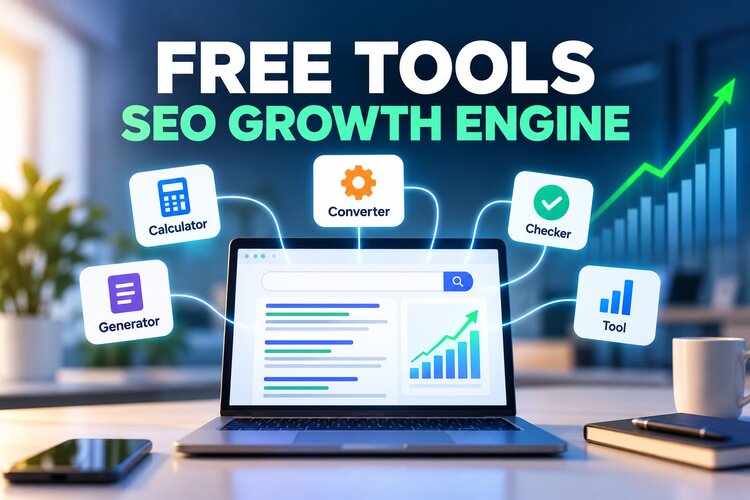
Most SEO strategies begin with content: identify a query, publish a useful page, and try to become the best answer in the search results. That model works well when the searcher wants information. But many searches are not really requests for an explanation. They are requests to do something.
A visitor may want to calculate a percentage, resize an image, generate structured data, convert a file, check a configuration, compare two values, or transform a block of text. For these queries, another article is often not the most useful result. A small utility can satisfy the intent more directly.
That creates an interesting SEO opportunity. A genuinely useful free tool can become more than a landing page: it can attract recurring search demand, earn links naturally, introduce new users to a brand, and create a bridge from informational discovery to a product or service.
But “build free tools” is not a strategy by itself. Development has a cost, many tool ideas have little demand, and some utilities become obsolete quickly. The real challenge is deciding which tasks deserve a tool and whether the economics justify building one.
Why free tools can perform differently from ordinary SEO content
An article and a tool solve different kinds of problems. An article primarily transfers knowledge. A tool transforms an input into an output.
Consider the difference between these two searches:
- “What is JSON?” — the user primarily needs an explanation.
- “JSON formatter” — the user already has data and wants to perform a task.
Publishing a long guide for the second query may add context, but the central experience still needs to be the formatter. Search intent is functional.
This distinction matters because utility-oriented searches often create repeat usage. Someone may read an explanation once, while a developer, marketer, designer, student, or business owner may return to the same calculator or generator dozens of times.
That repeat utility can produce several compounding benefits: direct traffic from returning users, branded searches, bookmarks, natural citations, links from tutorials, and exposure to related products or content.
The Netzender seven-factor framework for evaluating a tool idea
Before writing code, evaluate the opportunity across seven dimensions: Task, Demand, SERP Gap, Utility, Distribution, Economics, and Measurement. A promising tool does not need to dominate every dimension, but serious weaknesses in several of them are a warning that the idea may be expensive content disguised as software.
1. Task: is there a specific job the visitor needs to complete?
Start with the user task, not the keyword. The best utility ideas usually have a clear input and a clear desired output.
Examples include:
- paste JSON → receive formatted and validated JSON;
- upload an image → receive a resized image;
- enter dimensions → calculate an aspect ratio;
- enter revenue and cost → calculate margin;
- provide a topic → generate a structured starting template;
- enter a URL → inspect a technical property.
If you cannot describe the transformation in one sentence, the idea may be too broad for a focused utility.
2. Demand: do people repeatedly search for the task?
Search volume is useful, but it should not be the only signal. Look for a cluster of related queries rather than one attractive keyword.
A hypothetical image utility, for example, might serve searches around “image resizer,” “resize image online,” “resize JPG,” “change image dimensions,” and specific dimension-based queries. Individually these terms may vary, but together they can represent a durable task category.
Also consider whether demand is recurring or event-driven. A tool that solves a permanent workflow problem has different economics from one built around a temporary trend.
3. SERP Gap: are current results solving the task well?
High search demand does not automatically mean opportunity. A query dominated by excellent, fast, trusted tools may be much harder to enter than its volume suggests.
Inspect the actual results and ask practical questions. Are the leading tools slow? Do they require registration before providing the result? Are they overloaded with advertising? Do they work poorly on mobile? Is the interface confusing? Are important options missing? Does the user have to upload sensitive data unnecessarily?
The opportunity is not simply “this keyword has traffic.” The stronger thesis is: users have a recurring task and the existing results leave a meaningful problem unsolved.
4. Utility: can we produce a meaningfully better experience?
A thin page wrapped around a trivial script is unlikely to create a durable advantage. The tool should work reliably and make the user's task easier.
For many utilities, quality comes from small details: immediate results, sensible defaults, clear error handling, mobile usability, privacy explanations, copy/download actions, examples, accessible controls, and an explanation of what the result means.
Speed matters too. If the task can run in the browser, client-side processing may improve both responsiveness and privacy because the user's data does not need to leave the device.
5. Distribution: can the tool earn discovery beyond one keyword?
A useful tool should ideally connect to a broader topic ecosystem. Think beyond ranking one URL for one head term.
A percentage calculator might support educational pages about percentages, margins, discounts, growth rates, and financial formulas. A technical checker might connect naturally to troubleshooting guides and documentation. An image tool could support tutorials about dimensions, formats, compression, social media images, and web performance.
This creates an internal distribution loop: informational content introduces the utility, while the utility gives those articles a practical next step.
6. Economics: what happens if the tool succeeds?
Traffic alone does not make a tool valuable. Before development, define what success can contribute to the business.
Possible outcomes include advertising revenue, product discovery, email acquisition, qualified leads, affiliate revenue, paid upgrades, API usage, brand awareness, or simply lower customer-support friction.
The business model should not damage the utility. A calculator that hides its result behind an aggressive signup wall may convert some visitors, but it also weakens the very experience that made the page attractive in search.
7. Measurement: how will we know whether it worked?
Do not stop at pageviews. A tool should have a measurement plan that reflects its actual job.
Useful metrics can include search impressions, organic clicks, ranking query diversity, successful tool completions, repeat visits, engagement with the output, internal clicks to related pages, backlinks, branded searches, conversions, and revenue per visitor.
Measure failures as well. If thousands of users reach a tool but abandon it before generating a result, traffic is hiding a product problem.
A simple decision matrix before development
A lightweight scoring model can prevent attractive keywords from automatically becoming development projects. Score each factor from 1 to 5.
| Factor | Question | Strong signal |
|---|---|---|
| Task clarity | Is the job specific? | Clear input and useful output |
| Search demand | Is there recurring discovery? | Multiple relevant query patterns |
| SERP gap | Can current results be improved? | Visible usability or feature weakness |
| Utility advantage | Can we build something better? | Faster, simpler, safer or more capable |
| Distribution | Does it connect to a topic cluster? | Several natural supporting pages |
| Economics | Can success create business value? | Clear monetization or strategic outcome |
| Measurement | Can success be observed? | Defined usage and conversion events |
A project scoring 30 out of 35 deserves much more attention than one scoring 15, even if the weaker idea has a larger headline keyword. The exact threshold is less important than forcing the team to evaluate the same dimensions consistently.
Example: evaluating an image resizer
Suppose a site is considering a free image resizer.
The task is obvious: the user has an image and needs different dimensions. Search demand exists across many variations. The SERP, however, is competitive, so simply reproducing a basic width-and-height form offers little differentiation.
The idea becomes more interesting if research uncovers a specific gap—for example, fast browser-based resizing without upload, presets for common publishing formats, batch processing, format conversion, or a workflow that preserves privacy.
The surrounding content opportunity is also broad: image dimensions, aspect ratios, web performance, file formats, social image sizes, and optimization tutorials.
That is a much stronger investment thesis than “image resizer has high search volume.”
When an article is better than a tool
Not every query should become software. If the user's main need is judgment, explanation, comparison, news, interpretation, or a nuanced recommendation, editorial content may be the better format.
A tool is also a poor choice when inputs cannot produce a trustworthy result, when maintenance requirements are disproportionate to the opportunity, or when the utility would merely imitate mature products without improving the experience.
The format should follow the job. Sometimes the best result is an article. Sometimes it is a calculator. Often the strongest page combines both: the utility completes the task while concise supporting content explains the inputs, output, limitations, examples, and next steps.
How to design a tool page for search and users
The tool itself should appear quickly. Do not force users through a long essay before they can complete the task.
A strong utility page commonly has this order:
- a precise title and one-sentence explanation;
- the interactive utility;
- clear result and action controls;
- brief instructions or examples;
- an explanation of the calculation or transformation;
- limitations and privacy information where relevant;
- frequently asked questions;
- links to genuinely related resources.
This structure serves both audiences: visitors who want an immediate answer can use the tool, while visitors who need context can continue reading.
Free tools should be products, not SEO decorations
The biggest strategic mistake is treating a utility as a keyword container. If the page exists primarily for search engines and the tool is an afterthought, users notice.
Instead, treat each promising utility like a small product. Define the job, test the interface, instrument usage, observe failure points, improve the output, and maintain it when browsers, APIs, standards, or user expectations change.
This product mindset also changes SEO prioritization. The question stops being “How many tool pages can we publish?” and becomes “Which small products can become the best answer to recurring tasks in our market?”
Frequently asked questions
Do free tools help SEO?
They can. A useful tool may attract search traffic, links, repeat visitors and branded discovery when it satisfies a real recurring task. Building a tool does not guarantee rankings; relevance, quality, competition, technical accessibility and overall search performance still matter.
What kinds of free tools work well for search?
Calculators, converters, generators, validators, checkers, formatters and lightweight analysis tools are common candidates because they map naturally to task-oriented queries. The best format depends on what the searcher actually needs to accomplish.
Should the tool and supporting article use separate URLs?
There is no universal rule. If both target essentially the same intent, one strong page may be clearer. If an educational guide answers a different question from the utility, separate pages can make sense and can link naturally to each other.
Should a free SEO tool require registration?
Only when registration is necessary for the experience or provides enough additional value to justify the friction. For simple utilities, allowing visitors to complete the core task immediately often creates a stronger first experience.
How should a free tool be monetized?
Monetization should match the audience and the task. Options include advertising, premium capabilities, lead generation, related products, subscriptions, APIs and affiliate offers. Avoid monetization patterns that make the free result unnecessarily difficult to obtain.
A practical workflow
For teams considering utility-driven SEO, the process can be kept simple:
- collect recurring tasks from keyword research, customer questions and existing workflows;
- group related queries by the job the user wants to complete;
- inspect current search results manually;
- identify a specific experience gap;
- score the opportunity across the seven factors;
- prototype the smallest version that solves the task well;
- measure successful usage, not only visits;
- expand only after the initial utility demonstrates value.
This approach keeps development tied to evidence rather than enthusiasm.
Final takeaway
Free tools can become powerful SEO assets because they move beyond answering questions and help users complete tasks. But the opportunity is not created by the word “free,” and it is not created by search volume alone.
The strongest candidates sit at the intersection of recurring task demand, an identifiable gap in existing results, a genuinely better utility, natural distribution opportunities, and sustainable economics.
Evaluate those conditions before development. Build the smallest useful product. Measure whether people actually use it. Then let search growth be the consequence of utility rather than the only reason the tool exists.
Research and further reading
This Netzender analysis was developed independently after reviewing industry discussions about utility-driven SEO, including Ahrefs' research on free-tool SEO strategies. The source provided topic context; the framework, structure, analysis, examples and recommendations above are Netzender's own editorial treatment.