Walmart Meta Muse Shopping: Black Friday 2026 Controls
Walmart now supports shopping through Meta Muse. Review purchase approvals, spending limits, privacy and order details before an AI-assisted Black Friday purchase.
 Netzender Editorial Team

Quick answer: Walmart announced on November 24, 2026 that Meta's Muse can help customers discover its Black Friday products, assemble a basket and complete a purchase. Before trying an AI shopping agent, review its permission settings, inspect the exact basket and check the final total. Treat your approval as a decision about a particular order, rather than a general instruction to find a bargain. Walmart's launch announcement is the primary source for the new connection.
Checked November 25, 2026. This is an announcement-based analysis for readers shopping in the Walmart.com context, not a hands-on product test. Availability and the controls shown in a particular account should be checked in the service itself.
Why AI shopping is a timely Black Friday story
The practical question this holiday season is moving beyond whether an assistant can suggest a gift. It is whether shoppers understand the point where a suggestion becomes permission to spend.
In a November 19 survey announcement, DHL eCommerce reported that 88% of surveyed Black Friday shoppers had used or planned to use AI to compare prices, while 47% had already used AI chat or virtual assistants to browse or buy. The wider research covered 29,000 online shoppers across 29 countries. Those figures describe reported behavior and intentions; they do not measure the accuracy of an assistant or prove that it finds the lowest price.
Meta had already listed Walmart among additional shopping connections in its September Connect 2026 announcements. The newer Walmart release describes a concrete shopping flow through Muse. Keeping those dates separate avoids presenting an earlier partnership announcement as evidence that every feature was already usable.
What Walmart says the Muse connection does
According to the retailer, shoppers start with a request in Muse, connect through Walmart sign-in and set up an Agent Profile when adding their first cart item. Checkout can happen in the conversation using a card already saved with Walmart. The company also says the Walmart prices apply and its return policy remains relevant. These are retailer-described capabilities, not results from an independent checkout test.
The announcement does not provide a complete country, device and account eligibility matrix. Check the actual experience available to you before assuming that instructions for another market or account will match yours. Nor does access to a retailer's catalog establish that an agent has compared every competing store or selected the best overall offer.
A spending limit and an approval are different controls
Walmart's October 21 Agent Profiles explanation describes choices between requiring approval for each purchase and permitting purchases within a customer-set limit. It also says purchase approval is the default and additional approval may still be required. Read the explanation attached to the settings you actually see.
As a decision framework, a limit answers how much you are willing to spend. Approval answers whether you accept this item, from this seller, under these terms. A basket can be below your budget and still contain the wrong model, an unwanted bundle or an arrival date that misses your deadline.
For an initial purchase, our editorial recommendation is to retain a review step and start with an item whose specification is easy for you to check. This is a cautious way to evaluate a workflow, not a claim that a particular setting eliminates mistakes.
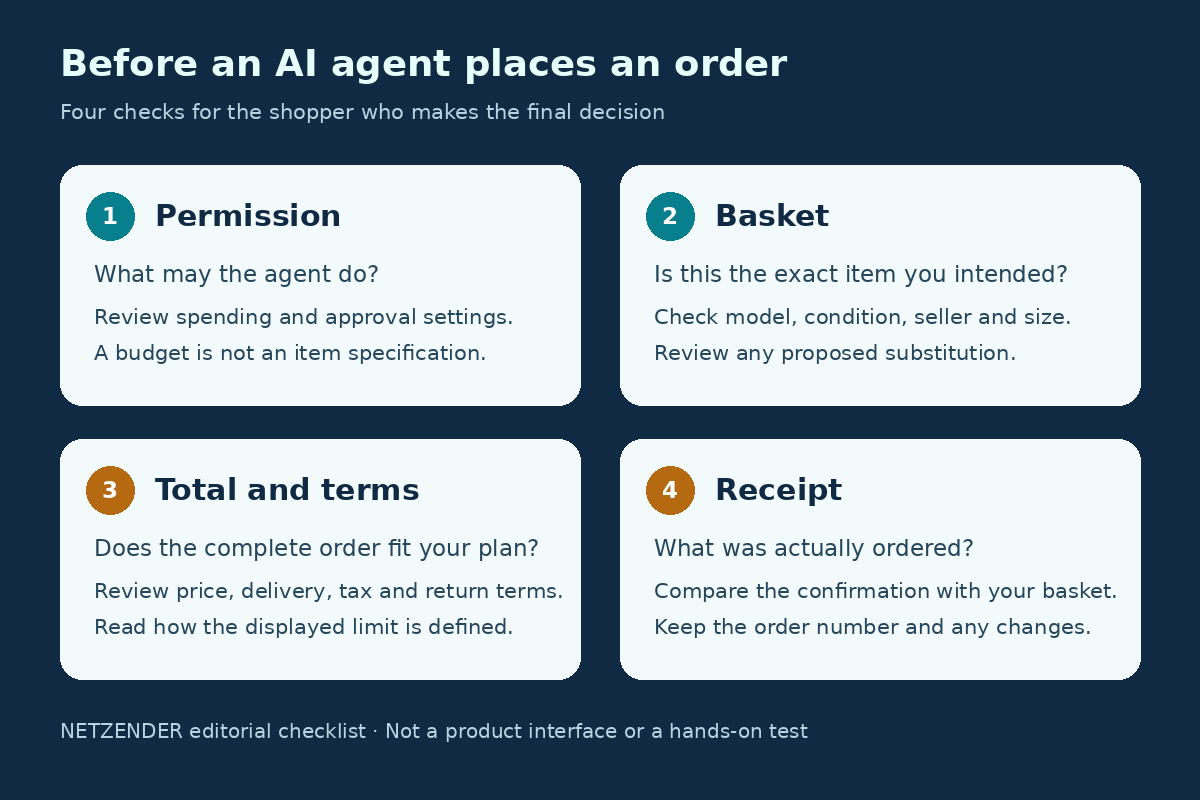
A four-part review for your first AI-assisted order
1. Write a request you can check
Replace a broad instruction such as finding something good with a short specification. Identify the product category, the must-have features, the maximum all-in budget and any unacceptable substitutions. If timing matters, include the date by which the item must arrive.
Illustrative request: Find one new pair of over-ear headphones compatible with my device. Exclude refurbished items and bundles. Show the exact model, seller, delivery estimate and complete total for my review before any purchase.
This is an example of clear requirements, not verified Muse command syntax or a guarantee that the assistant will enforce every condition. Its value is that it gives you a reference against which to review the proposed basket.
2. Inspect the basket independently of the recommendation
Open the proposed item details and compare the product identifiers with your request. A familiar product-family name is not enough when storage, generation, connectivity or included accessories can differ. Check the stated condition and seller as well as the product name.
The FTC's online-shopping guide recommends using product and model details when comparison shopping and checking the complete cost and terms. In an agent-assisted flow, that check belongs after the shortlist is prepared and before you authorize the order.
If the item is a substitute, decide whether it meets the original purpose. Do not let a fluent explanation replace a specific comparison. A shorter shortlist that you can verify is more useful than a longer list whose differences are unclear.
3. Calculate the total that matters to you
Judge the complete proposed order against your own budget, including the charges shown at checkout. Read how the service defines a spending limit rather than assuming that every platform applies it to the same components or time period.
Illustrative arithmetic, not a live offer: a $120 item plus $18 delivery and $10 estimated tax totals $148. Your own $140 all-in budget would not cover that order even though the item alone costs less than $140. The figures are invented solely to show the calculation; they are not a Walmart quote or a tax estimate for a particular location.
Also distinguish the retailer's price from a market-wide comparison. Microsoft's shopping help, for example, warns that assistants can make mistakes and that retailers control prices and availability. That is a useful reminder when evaluating AI-generated shopping information generally, not evidence that Microsoft and Muse have identical features.
4. Review the terms and keep the confirmation
Check the arrival estimate and the return conditions attached to the actual item. A broad holiday promotion is not enough to establish a specific return deadline or exception. The FTC guide also recommends keeping purchase records; an order number and the promised terms make follow-up more practical.
After you authorize a purchase, compare the confirmation with the basket you reviewed. Look for an unexpected quantity, changed variant or different total. If the screen times out, check your order history and confirmation before submitting the same purchase again. A delayed display alone does not establish that the order failed.
For a separate check on seller authenticity and suspicious ads, use our Black Friday shopping-scam guide. This article addresses delegation and order review; that guide covers the fraud checks in more detail.
Read the data-sharing promise narrowly
Walmart says the Gateway is designed to support relevant shopping without sharing a customer's broader purchase history with an agent. Its terms also state that agents do not receive payment-card information or change payment methods. The same explanation says the agent provider's privacy policy applies to information the agent receives.
Those statements should not be turned into a blanket claim that no data moves between services. Information you type into an assistant is a separate consideration from what a retailer exposes through a connection. Review the app's current privacy explanation, the retailer's connection permissions and the controls for removing access.
A useful habit is to separate permission to perform a task from settings about stored conversations or model training. Our guide to Gemini history and training controls explores that distinction in a different service. It does not describe Muse's settings, but it shows why one switch should not be assumed to answer every privacy question.
What would count as a good first result?
For a shopper, success is more specific than an assistant producing an attractive recommendation. Use these acceptance criteria for your own review:
- The basket matches the requirements you wrote down, with any substitution identified.
- You understand the complete proposed cost and the relevant delivery and return conditions.
- The purchase uses the authorization approach you intended, and the confirmation matches the order you reviewed.
If one of those checks fails, revise the request or complete the purchase yourself. If you are interested in the engineering behind that approach, our agentic AI project roadmap covers approval gates, failure tests and observability. The same discipline is useful at the shopping end of an automated workflow.
Frequently asked questions
Can Muse complete a Walmart purchase?
Walmart's November 24 announcement says the connection supports purchasing as well as product discovery. Confirm the feature and eligibility in your account rather than assuming universal availability.
Does an AI recommendation prove that a deal is cheapest?
No. Inspect the exact product and final price, and decide whether a separate comparison is needed. A recommendation, a retailer's advertised price and a verified best-price finding are different things.
Editorial transparency: This article was prepared with AI assistance from the linked primary sources. The review framework and hypothetical example are Netzender editorial guidance, not hands-on performance findings. The cover is an original AI-generated illustration; the checklist is an original editorial graphic. No affiliate links are included.