Can You Change What AI Says About Your Brand? AI Reputation Signals
Learn which AI reputation signals brands can influence, how to correct inaccurate information, and how to build a stronger evidence ecosystem for AI search.
 Netzender Editorial Team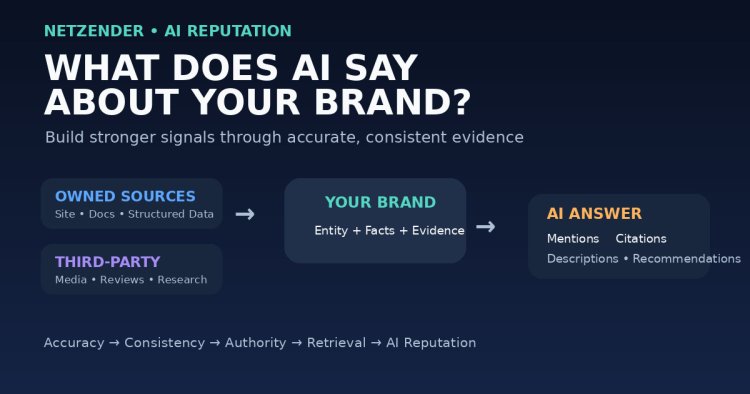
You cannot press a button and change what an AI system “thinks” about your brand. But you can improve the public evidence, entity information, and source material that search-enabled AI systems may use when describing your company.
That distinction matters.
When an AI assistant gives an outdated description, misses an important product, confuses your company with another entity, or repeats an inaccurate claim, the durable response is not to chase a secret prompt or “AI reputation hack.” It is to improve the information environment around the brand.
This guide explains the practical signals you can control, the signals you can only monitor, and how to build an AI reputation workflow without pretending that any publisher can directly control a model's answer.
What Is AI Reputation?
AI reputation is the way a brand, product, organization, or person is represented across AI-generated search and answer experiences.
- whether the brand is mentioned at all;
- which topics the brand is associated with;
- how products or services are described;
- which facts are repeated;
- which pages are cited as evidence;
- which third-party sources are used;
- whether information is current or outdated;
- whether the brand is recommended, compared, or omitted.
Unlike a traditional SERP, an AI-generated answer may synthesize information from multiple sources into one response. That means brand reputation in AI is partly an evidence problem, not only a ranking problem.
Can You Directly Change What AI Says About Your Brand?
Usually, no.
Public search and AI platforms do not provide a universal control panel where a company can rewrite the model's description of its brand.
What you can control is the information you publish, the clarity of your entity data, how accessible your pages are, how quickly you correct outdated information, and how consistently the same facts appear across your owned properties.
You can also influence the broader evidence ecosystem through public documentation, product pages, research, press resources, support content, expert contributions, and accurate third-party references.
Think in Terms of Evidence, Not Opinion
A better question is:
What evidence is available, retrievable, understandable, current, and consistent enough to support the answer?
Search-enabled AI experiences can retrieve web content and use it as grounding material.
A negative or inaccurate answer may happen because:
- your owned information is unclear;
- authoritative pages are outdated;
- third-party sources dominate the topic;
- the system retrieved an old page;
- your brand is ambiguous;
- the query triggers unexpected sources;
- the generated answer is simply wrong.
1. Make Your Brand Entity Unambiguous
Your official website should consistently state:
- organization name;
- alternate name if relevant;
- what the organization does;
- official website URL;
- logo;
- contact information;
- key products and services;
- important authors, founders, or experts;
- relevant external profiles.
Google says Organization structured data can help it understand administrative details and disambiguate an organization.
2. Create a Strong Source of Truth
Your website should contain authoritative pages for important brand facts:
- About page;
- product pages;
- pricing documentation;
- feature documentation;
- support and policy pages;
- press or media page;
- research methodology;
- company timeline;
- leadership profiles;
- security and privacy documentation.
This is particularly important for information that changes frequently.
3. Fix Contradictions Across Your Properties
Conflicting information creates ambiguity.
- old pricing pages remain indexed;
- product names are inconsistent;
- different author bios show different roles;
- old documentation describes discontinued features;
- different pages describe different target audiences.
Audit contradictions before trying to optimize AI visibility.
4. Keep Important Facts Fresh
Freshness matters most for:
- pricing;
- leadership;
- product features;
- supported markets;
- availability;
- policies;
- technical specifications;
- security information.
Update the underlying facts, not just the date displayed on the page.
5. Make Claims Verifiable
Generic statements such as “best platform” or “leading solution” provide weak evidence.
Concrete information is more useful:
- what a product does;
- what features it supports;
- how a test was performed;
- what a dataset contains;
- when information was updated;
- which limitations apply.
6. Strengthen Third-Party Evidence
Your own site is only one part of the information ecosystem.
AI systems may encounter:
- news coverage;
- industry publications;
- directories;
- review platforms;
- research reports;
- public documentation;
- community discussions;
- partner pages;
- conference profiles.
Focus on legitimate external references rather than manufactured consensus.
7. Improve Crawl and Search Eligibility
OpenAI's publisher guidance recommends allowing OAI-SearchBot if you want public content to be discoverable in ChatGPT Search.
Google similarly requires pages to be indexed and eligible for Search before they can appear as supporting links in its generative AI features.
Review:
- robots.txt;
- noindex directives;
- canonical tags;
- HTTP status codes;
- duplicate URLs;
- crawl accessibility;
- sitemaps;
- internal linking.
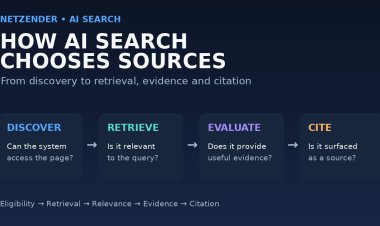
See How AI Search Engines Choose Sources for Their Answers.
8. Monitor Mentions and Citations Separately
A brand can be mentioned without its website being cited, and a website can be cited without the brand being prominently mentioned.
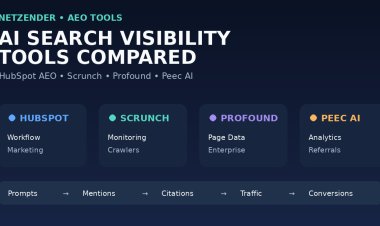
Read our guide to AEO mentions vs. citations.
Track:
- brand mention rate;
- citation rate;
- cited URLs;
- topics associated with the brand;
- competitors mentioned alongside you;
- incorrect or outdated claims;
- AI referral visits;
- conversions from AI traffic.
9. Look for Patterns, Not One-Off Answers
AI outputs can vary by platform, prompt wording, location, time, sources, product version, and conversation context.
Create a controlled prompt set such as:
- What does [Brand] do?
- Who is [Brand] for?
- What are the main products from [Brand]?
- What are the strengths and limitations of [Brand]?
- How does [Brand] compare with [Competitor]?
- Is [Brand] suitable for [use case]?
Classify answers as accurate, incomplete, outdated, ambiguous, or incorrect.
10. Use First-Party AI Visibility Data
Bing Webmaster Tools provides AI Performance reporting including citation activity, cited pages, grounding queries, topics, intents, and Citation Share.
See Microsoft's AI Performance announcement.
11. Separate Factual Errors From Negative Opinions
An unfavorable comparison is not necessarily a factual error.
The remediation differs:
- Factual error: improve authoritative evidence.
- Incomplete answer: improve coverage.
- Reasonable negative comparison: improve product positioning or evidence.
- Unsupported harmful claim: document and report it where appropriate.
12. Build a Brand Fact Sheet
Maintain an internal fact sheet containing:
- official organization name;
- short description;
- product names;
- category;
- primary audiences;
- leadership;
- pricing model;
- supported regions;
- key features;
- important limitations;
- official source URLs;
- last verified date.
13. Create Content Worth Using as Evidence
Useful original assets include:
- proprietary research;
- benchmarks;
- calculators;
- datasets;
- case studies;
- technical documentation;
- transparent comparisons;
- expert commentary;
- original experiments;
- practical guides.
Google's people-first content guidance emphasizes creating content primarily to help users rather than merely attract search traffic.
14. Avoid AI Reputation Spam
Avoid:
- mass-producing near-duplicate brand pages;
- fake reviews;
- fabricated expert quotes;
- keyword-stuffed company descriptions;
- publishing dozens of pages repeating identical facts;
- unsupported superlatives;
- automated reputation content without editorial review.
15. A Practical AI Reputation Workflow
Step 1: Define critical brand facts
List the facts that must remain accurate.
Step 2: Test representative prompts
Run a stable prompt set across relevant AI platforms.
Step 3: Record inaccuracies
Separate factual errors from incomplete or outdated information.
Step 4: Inspect supporting sources
Identify which pages and domains are influencing the answer.
Step 5: Repair owned evidence
Update canonical pages, structured data, internal links, and obsolete information.
Step 6: Strengthen external evidence
Earn legitimate coverage through useful research, data, tools, and expertise.
Step 7: Measure again
Track patterns over time instead of relying on one generated response.
How Long Does It Take for AI Answers to Change?
There is no universal timetable. Different systems crawl, retrieve, index, cache, and regenerate information differently.
Focus on improving the broader source ecosystem rather than expecting immediate prompt-level changes.
Can Structured Data Fix AI Reputation?
No.
Structured data can reinforce accurate organization facts and help disambiguate entities, but it cannot override weak or contradictory visible content.
Can You Remove a Negative AI Answer?
There is no universal removal mechanism for ordinary unfavorable AI-generated opinions.
For factual errors, improve authoritative evidence. For harmful, illegal, private, or clearly false information, use the relevant platform's reporting or legal channels where appropriate.
AI Reputation Checklist
- Verify official organization information.
- Maintain accurate Organization structured data.
- Create canonical pages for important brand facts.
- Remove or redirect obsolete factual pages.
- Keep pricing, products, and policies current.
- Use consistent organization and product names.
- Support important claims with evidence.
- Allow appropriate search crawlers.
- Track mentions separately from citations.
- Monitor cited URLs and grounding contexts.
- Review representative prompts periodically.
- Earn legitimate third-party references.
- Publish original assets worth citing.
- Measure changes over time.
Final Takeaway
You cannot directly program what an AI system says about your brand, but you can improve the evidence it may encounter.
Make your organization unambiguous, maintain accurate first-party sources, correct contradictions, keep important facts current, support claims with evidence, and build legitimate external references.
The goal is not to manipulate one generated answer. It is to create a durable, verifiable information ecosystem in which accurate descriptions of your brand are easier to discover, retrieve, and support.
16. Audit the Pages That Define Your Brand
Not every page contributes equally to how a brand is understood. Start with the pages that contain the strongest identity, product, and factual signals.
Prioritize your homepage, About page, main product pages, pricing pages, leadership profiles, documentation, security pages, press resources, and other URLs that define important facts about the organization.
For each page, identify its critical claims and compare them with the rest of the site. Contradictions are especially common after rebrands, acquisitions, product renaming, pricing changes, leadership changes, and feature launches.
If one page says a feature is available while another says it is not, search and AI systems have to resolve information that your own organization should already have made consistent.
17. Build Topic-Level Evidence
AI reputation is not only about whether a system recognizes your company name. It is also about the topics with which your brand becomes associated.
A cybersecurity company may want authoritative evidence around identity protection, endpoint security, ransomware prevention, and incident response. A marketing platform may want strong evidence around analytics, automation, attribution, CRM integrations, and campaign management.
Create useful resources for topics where your organization genuinely has expertise. These might include definitions, technical explainers, original research, benchmarks, product documentation, expert commentary, case studies, methodology pages, and transparent comparisons.
This creates a stronger evidence ecosystem than repeatedly publishing pages that simply describe the company as an expert.
18. Track Which Sources Influence AI Descriptions
When an AI answer provides citations, inspect the sources instead of looking only at the final wording.
Ask whether the answer relies on your own website, an old news story, a review platform, a competitor comparison, a forum discussion, or another third-party source.
If an outdated third-party page repeatedly shapes the description, you may not be able to edit it directly. But you can publish clearer current evidence, request factual corrections where appropriate, and make newer authoritative sources easier to discover.
The goal is not to eliminate independent sources. The goal is to make sure accurate and current evidence is available alongside them.
19. Measure Reputation by Topic and Intent
A single AI visibility score can hide important differences.
Your brand might perform well for informational questions while performing poorly for comparisons or buying-intent prompts.
Segment monitoring into groups such as:
- Brand: What is [Brand]?
- Product: What does [Product] do?
- Comparison: [Brand] vs. [Competitor].
- Recommendation: Best tools for [use case].
- Trust: Is [Brand] reliable?
- Feature: Does [Brand] support [feature]?
This makes reputation work actionable. Instead of saying AI visibility changed, you can identify which topic, product, or intent actually changed.
20. Maintain an AI Reputation Change Log
Keep a lightweight record of meaningful changes made to the information ecosystem.
- page updated;
- fact corrected;
- structured data changed;
- obsolete URL redirected;
- new research published;
- third-party correction obtained;
- product documentation refreshed.
Then compare those changes with later mention, citation, referral, and conversion trends. This does not prove causation, but it creates a disciplined way to evaluate reputation work over time.
21. Treat AI Reputation as an Ongoing Publishing Discipline
AI reputation management is not a one-time technical project. Products change, pricing changes, executives change roles, new competitors appear, and AI platforms continuously update their retrieval systems.
The durable process is operational: maintain accurate source-of-truth pages, review critical facts, publish evidence worth citing, correct contradictions quickly, and monitor mentions, citations, referral traffic, and conversions separately.
This turns AI reputation into part of normal SEO, editorial, communications, and product-documentation work rather than a reactive attempt to influence one generated answer.