How AI Search Engines Choose Sources for Their Answers
Learn how AI search engines retrieve, ground, evaluate, and cite web sources—and which SEO fundamentals improve your chances of being selected.
 Netzender Editorial Team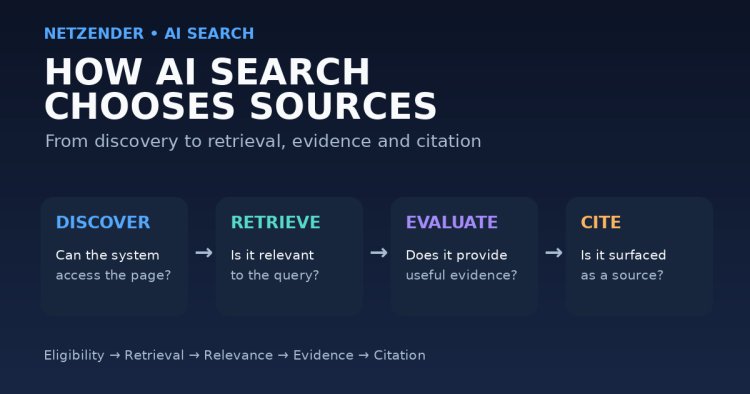
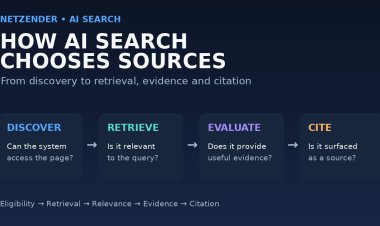
AI search engines do not choose sources in exactly the same way traditional search engines rank ten blue links. Before a source can appear in an AI-generated answer, the system generally has to discover the page, retrieve it for a relevant question, determine that its information helps support the response, and decide whether to surface it as a visible citation or supporting link.
The exact algorithms behind systems such as Google AI Mode, AI Overviews, Microsoft Copilot, and ChatGPT Search are proprietary. There is no public checklist that guarantees a citation.
However, first-party documentation from Google, Microsoft, and OpenAI reveals enough about discovery, retrieval, grounding, and citation to build a practical model for understanding how AI search sources are selected.
This guide separates what the platforms actually document from assumptions that are often repeated as “AI ranking factors.”
The Short Version: Eligibility → Retrieval → Evidence → Citation
A useful mental model is:
Eligibility → Retrieval → Relevance → Evidence → Citation
These stages are related, but they are not interchangeable.
- Eligibility: Can the platform access and use the page?
- Retrieval: Does the system retrieve the page for the question or one of its related subqueries?
- Relevance: Does the page contain information relevant to the specific task?
- Evidence: Is the content clear and useful enough to support part of the generated answer?
- Citation: Does the interface visibly reference the page as a source?
A page can pass one stage and still fail at the next. Being indexed does not guarantee retrieval. Being retrieved does not guarantee citation. And being cited does not guarantee a click.
1. A Page Must First Be Discoverable and Eligible
The first requirement is basic but easy to overlook: an AI search system needs a way to access or discover the page.
For Google Search, the company states that a page must be indexed and eligible to appear in Search with a snippet before it can appear as a supporting link in AI Overviews or AI Mode.
Google also says there are no special technical requirements that exist only for AI Overviews or AI Mode. Core SEO fundamentals still matter.
For ChatGPT Search, OpenAI advises publishers who want their public content to be discovered, surfaced, summarized, and cited to allow OAI-SearchBot access.
This means AI search optimization starts with familiar technical foundations:
- crawlable URLs;
- indexable pages;
- correct canonicalization;
- stable HTTP responses;
- clear page structure;
- usable text content;
- robots directives that match your publishing intentions.
If a platform cannot reliably access a page, content quality alone cannot solve the visibility problem.
2. AI Search Can Break One Question Into Multiple Retrieval Tasks
One of the most important differences between generative search and classic keyword thinking is that one user question may trigger several retrieval operations.
Google documents a technique called query fan-out. AI Overviews and AI Mode can issue multiple related searches across subtopics and data sources while developing a response.
Consider a user asking:
What is the best CRM for a small agency that needs email automation and good reporting?
An AI search system might need information related to:
- CRM products for small agencies;
- email automation features;
- reporting capabilities;
- pricing;
- team size limits;
- integrations;
- comparisons between specific products.
The exact searches performed are not public, but the broader implication is important: your page does not necessarily need to match the wording of the original prompt exactly.
It needs to provide useful information for one or more parts of the information need.
3. Retrieval and Ranking Are Not the Same Question
Traditional SEO discussions often ask: “Where does this page rank?”
AI retrieval introduces another question:
Was this page useful enough to retrieve as evidence for the generated answer?
Google describes generative AI Search as using retrieval-augmented generation, or grounding, alongside its core Search ranking and quality systems to retrieve relevant and current pages from the Search index.
This means normal SEO is not obsolete. Search systems still need to understand, index, evaluate, and retrieve web documents.
But an AI-generated response may combine evidence retrieved for several related tasks rather than simply summarizing the first traditional result.
4. Grounding Helps Connect Generated Answers to Web Evidence
“Grounding” is a useful concept for understanding AI source selection.
Instead of relying only on information encoded in a model, a search-enabled AI system can retrieve external information and use it to support or update the answer.
Microsoft exposes part of this process to website owners through Bing Webmaster Tools.
Its AI Performance report includes grounding queries: grouped phrases associated with content retrieval and citation activity.
Microsoft makes an important distinction: these phrases are not necessarily the user's exact prompt. They are representations associated with retrieval activity.
This helps explain why keyword rank tracking alone cannot fully describe AI search visibility.
A page may be useful for a retrieval phrase that looks different from the wording a user originally typed.
5. Why One Page Gets Cited and Another Does Not
No major platform publishes a complete citation algorithm, so claims such as “AI always cites pages with X words” or “you need exactly five statistics to rank in ChatGPT” should be treated skeptically.
What the official guidance does consistently emphasize is content that is clear, relevant, useful, accurate, current, and structured in ways that make information understandable.
Bing's guidance for AI visibility specifically recommends:
- aligning content with user intent;
- strengthening depth and expertise;
- using clear headings and structure;
- supporting claims with evidence;
- keeping information fresh and accurate;
- maintaining consistency across formats.
Google's current guidance similarly emphasizes useful, unique, non-commodity content rather than producing large volumes of pages for every possible prompt variation.
6. Clear Structure Helps Systems Locate Useful Information
AI retrieval does not mean every page needs to look like a FAQ.
But a page should make its main information easy to identify.
Useful structural elements can include:
- descriptive H2 and H3 headings;
- short definitions near the relevant heading;
- comparison tables;
- step-by-step instructions;
- clearly labeled examples;
- lists where a list is genuinely the best format;
- concise conclusions after complex explanations.
Structure benefits humans first, but it also reduces ambiguity when systems retrieve smaller portions of a longer document.
7. Specific Evidence Is More Useful Than Generic Claims
Compare these two statements:
Our platform is one of the best tools for modern marketing.
versus:
The platform supports scheduled email campaigns, five user roles, CSV exports, and attribution reports covering a 90-day window.
The second passage contains concrete information that can help answer specific questions.
Useful evidence may include:
- original research;
- measured data;
- documented product specifications;
- methodology;
- expert explanations;
- primary-source statements;
- examples;
- screenshots;
- first-hand testing;
- clearly sourced statistics.
This does not mean every article needs proprietary research. It means vague promotional language provides less usable evidence than specific, verifiable information.
8. Freshness Matters When the Question Requires Fresh Information
Not every query requires the newest page.
A mathematical definition can remain useful for years. Software pricing, travel rules, product specifications, security recommendations, AI product features, and regulations can change much faster.
Bing explicitly notes that citation activity may change because of content freshness, model changes, user demand, and other factors.
A sensible publishing workflow therefore identifies which content is time-sensitive and gives those pages a stronger refresh schedule.
Do not update the publication date without meaningfully reviewing the underlying facts.
9. Entity Clarity Reduces Ambiguity
An AI system should not have to guess what your company, product, author, or service represents.
Use precise language on important entity pages.
For a company, this can include:
- what the company does;
- which products it offers;
- who it serves;
- official product names;
- authors or subject-matter experts;
- consistent organization details;
- clear relationships between products and the parent organization.
Structured data can help search engines understand entities and page types, but markup does not substitute for useful visible content.
10. Authority Is Not a Single AI Citation Score
Be careful with third-party tools that turn AI visibility into one proprietary “authority score.”
Bing explicitly warns that its citation metrics do not represent ranking, authority, importance, traffic, or page quality.
A citation means that a page was visibly referenced in an AI-generated answer within the measured experience.
That is useful data, but it should not be interpreted as proof that a platform has assigned the page a universal authority score.
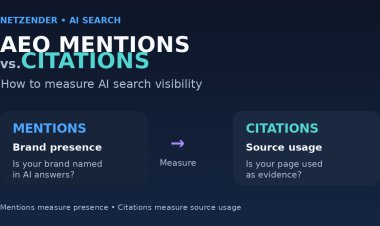
For a practical framework for separating these metrics, see our guide to AEO mentions vs. citations.
11. Traditional SEO Still Matters
Generative AI has changed the search interface, but it has not eliminated the underlying need for good search fundamentals.
Google states directly that SEO best practices continue to matter because its generative AI features are rooted in core Search ranking and quality systems.
That means teams should continue improving:
- crawlability;
- indexation;
- site architecture;
- internal linking;
- page experience;
- helpful content;
- technical consistency;
- content maintenance.
Browse more related guidance in Netzender's SEO section.
12. What About AEO and GEO Optimization Tricks?
AEO and GEO are useful labels for discussing visibility in answer engines and generative search.
They become misleading when presented as a completely separate replacement for SEO or as a list of secret formatting tricks.
Google's own guidance says that from its perspective, optimization for generative AI Search is still optimization for the search experience.
It specifically warns against producing many pages for every possible query or fan-out variation simply to manipulate generative AI visibility.
The more durable strategy is to publish a smaller number of genuinely useful resources that cover a topic with enough clarity, evidence, and depth to satisfy users.
13. How ChatGPT Search Fits Into the Model
OpenAI's public guidance provides another useful example.
Public websites may appear in ChatGPT Search, but placement is not guaranteed.
OpenAI advises site owners who want inclusion to allow OAI-SearchBot to access their content.
This gives us a familiar distinction:
Crawl eligibility is necessary for reliable discovery, but crawl eligibility does not guarantee selection.
The same principle applies broadly across search systems: technical access creates the opportunity to compete, while relevance and usefulness determine whether a page is useful for a particular information need.
14. A Practical Source-Selection Checklist
When reviewing a page that you want AI search systems to use, ask:
- Can major search crawlers access the page?
- Is the page indexable and canonicalized correctly?
- Does the page answer a real user need?
- Is the primary topic obvious from the title and headings?
- Does it contain concrete information rather than generic marketing copy?
- Are factual claims supported?
- Is important time-sensitive information current?
- Are products, people, organizations, and concepts named consistently?
- Can a useful passage be understood without reading the entire page?
- Does the page add something beyond summaries already available elsewhere?
- Does it connect naturally to deeper related resources?
15. How to Measure Whether the Strategy Is Working
Do not rely on a single third-party visibility score.
Different platforms expose different measurements.
Microsoft's AI Performance report can show cited pages, total citation activity, grounding queries, citation share, and related AI visibility information.
Google Search Console now provides a generative AI performance report covering supported Google Search generative experiences, including AI Overviews and AI Mode.
OpenAI also provides publisher guidance for measuring traffic that arrives from ChatGPT.
Combine those signals with analytics and business outcomes.
A useful reporting stack includes:
- generative AI impressions;
- cited URLs;
- citation activity;
- brand mentions;
- AI referral sessions;
- engagement;
- leads;
- conversions.
What We Know — and What We Do Not Know
We know that modern AI search experiences can retrieve external web information, use grounding, perform related searches, and display supporting sources.
We know that technical eligibility, standard SEO foundations, clear useful content, evidence, and freshness are repeatedly emphasized by the platforms themselves.
What we do not have is a public formula that tells us exactly why one URL was selected for every individual AI response.
Therefore, avoid turning correlations into universal rules.
If a study finds that many cited pages have a particular characteristic, that can be useful research. It does not automatically prove that the characteristic is a direct ranking factor.
Final Takeaway
AI search source selection is best understood as a pipeline rather than a secret checklist.
Your content first needs to be accessible and eligible. It then needs to be retrieved for a relevant information need, provide useful evidence, and be selected as a supporting source.
The durable strategy is therefore not to chase every possible prompt.
Build technically sound pages, answer specific questions clearly, provide original or well-supported information, keep important facts current, and measure which pages and topics actually earn AI visibility.
That approach improves your chances of being useful not only to generative search systems, but to the people those systems are ultimately trying to help.
Primary research references used for this guide: Google Search Central documentation on generative AI Search and AI features, Bing Webmaster Tools AI Performance documentation, and OpenAI publisher/search crawler guidance.
Primary Sources and Further Reading
This guide is based primarily on first-party documentation from the search and AI platforms discussed above:
- Google Search Central: AI features and your website
- Google Search Console: Generative AI performance reporting
- Bing Webmaster Tools: AI Performance
- OpenAI: Publisher and search crawler guidance
Platform documentation changes over time, so verify current implementation details before making technical or publishing decisions.